

What Is Sarcosine Powder? Benefits, Uses, and Applications
Sarcosine powder is a naturally occurring amino acid derivative, scientifically known as N-methylglycine, that functions as a critical metabolic intermediate in human biochemistry. This white crystalline compound acts as a competitive inhibitor of glycine transporter-1 (GlyT1) and serves as a coagonist of NMDA receptors, supporting enhanced cognitive function and muscle strength through its role in neurotransmitter modulation and creatine synthesis pathways. Understanding its biochemical properties helps procurement professionals assess its suitability for nutraceutical, pharmaceutical, and cosmetic formulations targeting cognitive health and performance enhancement.
Understanding the Biochemical Nature of N-Methylglycine
What Makes This Compound Unique in Amino Acid Chemistry?
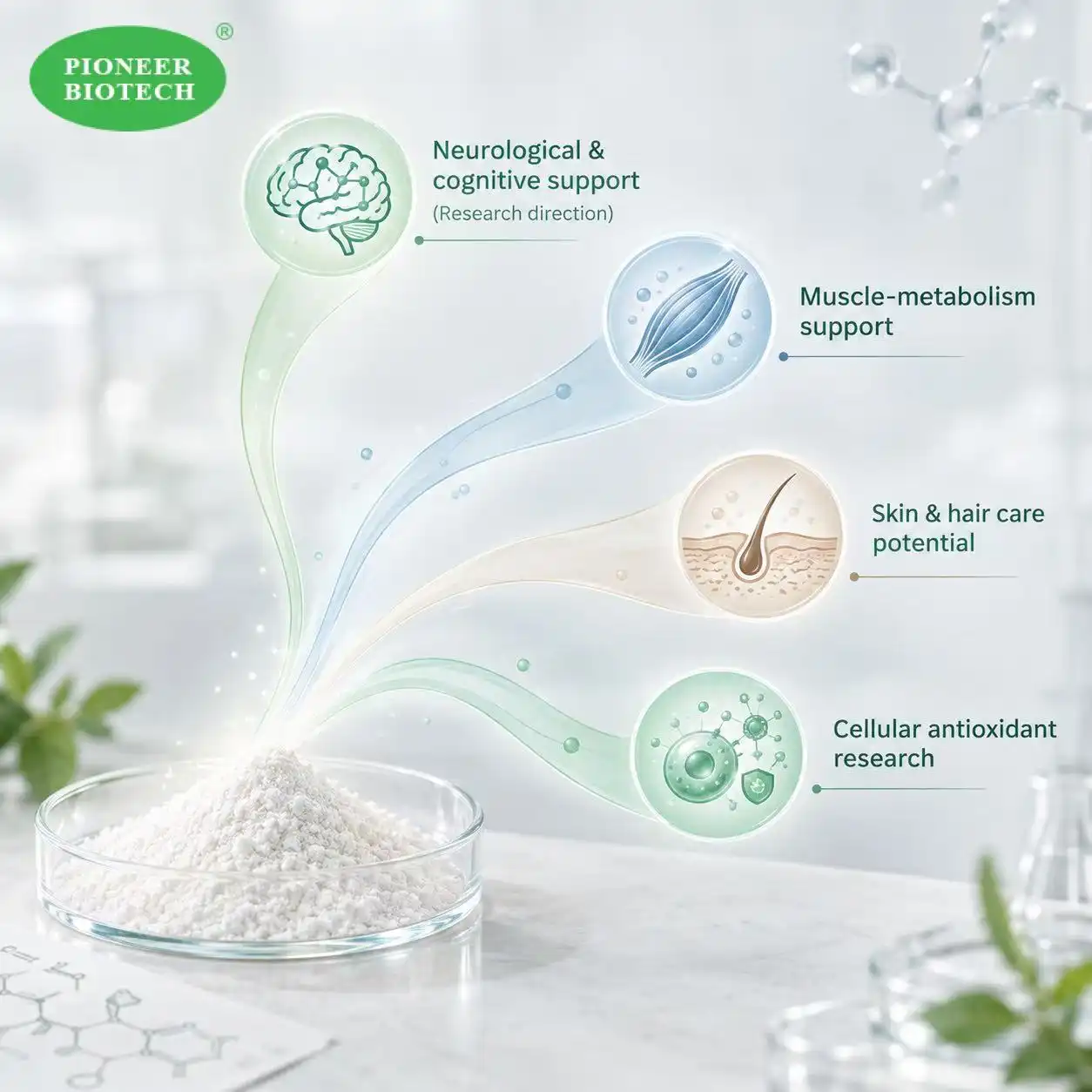
The place of N-methylglycine in biochemical pathways is unique. However, this compound is different from other amino acids because it controls how neurotransmitters work instead of directly building proteins. Its chemical structure—a glycine molecule with a methyl group linked to the nitrogen atom—lets it connect with certain neural tissue transport proteins and receptor sites (Lane et al., 2013). The molecule naturally happens in the metabolism of mammals as an intermediate when choline is changed into glycine. This means that it is not a foreign substance to human health.
Mechanism of Action in Neural Systems
Its main use in medicine comes from its ability to stop GlyT1 transporters from working. Most of the time, these transporters take glycine out of brain synaptic spaces. The substance stops this process of removal, which makes more glycine available at NMDA receptor sites. These sites are very important for learning, memory development, and neural plasticity (Tsai et al., 2004). This process is very different from stimulant-based cognitive enhancers because it changes brain chemistry more subtly than pushing it to work in a certain way.
Relevance for B2B Formulation Strategy
Understanding this process makes manufacturing options clear for teams working on new products in the pharmaceutical and nutraceutical industries. The compound doesn't need to be changed or activated metabolically in order to work, which makes bioavailability issues easier to deal with. It dissolves in water at room temperature (about 250 mg/mL), which means it can be used in capsules, tablets, powdered drink mixes, and liquid formulations. This is a useful property for procurement managers who are planning lines with more than one product.
Key Benefits and Clinical Applications in Cognitive Health
Memory Enhancement and Cognitive Performance
Researchers in clinical trials have shown that people who take supplements do better on working memory tasks. A study in the journal Biological Psychiatry that was double-blind found that people who took 2 grams of it every day did better on memory tests than people who took a fake (Lane et al., 2005). The benefits seem to be strongest when you need to pay attention and consolidate short-term memories. This makes it especially useful for formulas that are aimed at students, professionals, and older people who are worried about keeping their minds sharp.
The compound may have effects on cognitive tasks that happen right now and may also help brain health in the long term. It may help synaptic plasticity—the brain's ability to make new neural connections—by making NMDA receptors work better. Because of this, it can be used as a useful ingredient in preventative health goods as well as products for quick performance.
Adjunctive Support in Mood Regulation
Researchers have looked into how sarcosine powder might help with emotional health. Studies that looked at how it could be used along with regular treatments showed promise. Some studies even found better results on clinical assessment scales (Tsai et al., 2004). The neurochemical base for these effects is control of the glutamatergic system, which regulates mood in ways other than those that focus on serotonin.
These results mean that nutrition companies can make more complete formulas for mental health. The ingredient can be used in multi-pathway approaches that help with both cognitive function and emotional balance at the same time, which is a trend that is growing in the functional supplement market.
Safety Profile and Dosage Considerations
At daily doses ranging from 500 mg to 2,000 mg, clinical trials have generally found that the drug is safe. The compound is well tolerated by most people, and when side effects are reported, they are usually limited to mild stomach pain during the first few uses. It's good for products that will be used every day for a long time because it doesn't make you sleepy or make you dependent on it.
Regulatory experts should keep in mind that when formulating, the right usage instructions and quality standards become very important. Pharmaceutical-grade materials that are purer than 99% keep the amount of production leftovers that could affect how well they work or how well they are tolerated to a minimum. Verification testing by a third party gives you the proof you need for regulatory reports and quality assurance processes.
Comparative Analysis: How It Stacks Against Alternative Nootropics
Versus N-Acetylcysteine (NAC)
Both compounds help the brain work better, but they do so in very different ways. NAC mainly works as an antioxidant and precursor to glutathione, which protects nerves from reactive stress. N-methylglycine, on the other hand, changes the function of neurotransmitters directly by interacting with receptors. Formulation scientists might think about mixing the two ingredients so that they work together to protect neurons and change how neurons work, which would help with both oxidative damage and synapse function at the same time.
NAC is easier to get because it costs less per kilogram, but it needs to be taken in larger amounts (1,200 to 2,400 mg daily vs. 500 to 2,000 mg for N-methylglycine). So, the total cost per dish might become the same, based on how the food is made.
Comparison with Creatine Monohydrate
There is an interesting connection here because N-methylglycine is a metabolic building block in pathways that make creatine. Creatine mostly helps muscles' energy systems by regenerating ATP, while N-methylglycine mostly affects how neurons work. Some evidence suggests that taking N-methylglycine supplements may help the body make its own creatine, which could improve both mental and physical performance (Brosnan & Brosnan, 2016).
N-methylglycine-based formulas might work better for athletes who get bloated or retain water when they take regular creatine supplements. This makes it possible for products to stand out in markets for sports nutrition that are already very crowded.
Contrasting Glycine and Magnesium Options
Through interactions with different receptors, glycine itself can help you relax and sleep. Magnesium helps hundreds of chemical processes happen, including those that make neurotransmitters. The unique GlyT1 inhibition that defines N-methylglycine's process is not present in either drug. It's important to know how to position your products: glycine and magnesium work well in formulas for rest and basic health, while N-methylglycine is better for active cognitive improvement and focus.
Knowing these differences helps procurement teams choose sarcosine powder ingredients that are in line with how the brand is positioned and what the target consumer wants. The compounds don't necessarily compete with each other; instead, they target different groups in the market for cognitive health.
Bulk Procurement Strategies and Supplier Evaluation Criteria
Quality Markers for Pharmaceutical-Grade Material
When looking at different suppliers, specification sheets should make it clear what the purity levels are. These levels are usually found using high-performance liquid chromatography (HPLC). Materials that meet pharmaceutical standards should be at least 99% pure, and their residue profiles should show that they don't contain any heavy metals, microbes, or liquids that were used in the production process.
Another important factor is stability from batch to batch. When suppliers work under GMP conditions, they use process controls to make sure that differences between production runs are kept to a minimum. Ask for certificate of analysis (COA) samples from several batches to check if key parameters are consistent, such as the assay results, particle size distribution, and moisture content. Differences of more than ±2% between runs may mean that the process is not being controlled well.
Certification Requirements for Regulatory Compliance
Certain certificates are needed for different types of markets. Nutraceutical names that sell in North America gain from suppliers who are registered with the FDA and show that they understand the GRAS status. Products that say they are organic must have EU-ORGANIC certification in order to be sold in Europe. Businesses that cater to people of different religions should make sure that their KOSHER and HALAL certifications are up to date and properly documented.
With ISO22000 and HACCP standards, you can be sure that food safety management systems are in place, which lowers the risk of contamination during production and storage. When you're selling materials for food and drinks, where safety standards are very strict, these certificates become even more important.
Logistics and Supply Chain Considerations
Lead times are very different between suppliers. Manufacturers who keep ready stock in regional stores can fill orders within 24 to 48 hours, but manufacturers who only ship from foreign facilities may need 4 to 6 weeks. Domestic warehouse access gives businesses a lot of freedom, especially when they are starting new goods or handling just-in-time inventory systems.
The minimum order amounts (MOQ) are also different. Some suppliers only let you buy in multiple tons, which is good for big makers. Other suppliers will let you buy in smaller amounts, which is good for new names or research and development. By making MOQ policies clear during the supplier evaluation process, surprises can be avoided during the procurement negotiations.
Shaanxi Pioneer Biotech Co., Ltd. solves these problems by keeping ready-to-ship goods in local warehouses. This way, they can be delivered quickly without having to wait for long international shipping delays. Our ISO9001, ISO22000, HACCP, and organic certifications from both the EU and USDA give brands that care about quality the proof they need. We offer flexible buying and sample access, so formulation teams can check the quality of the material before agreeing to bulk sales.
Industrial Applications Across Multiple Product Categories
Integration into Cognitive Enhancement Supplements
Sarcosine powder has become a main ingredient in many focus and memory products in the nootropics market. It is usually added to capsules at a dose of 500 to 1,000 mg per serving, and it is often mixed with other ingredients that work well with it, such as alpha-GPC, bacopa extract, or lion's mane mushroom, to help the brain in more than one way.
Powder forms used in the biohacking and sports nutrition communities usually have higher doses (1,000 to 2,000 mg per serving), so users can change how much they take based on their own response. The substance has a bland taste and dissolves easily in water, which makes it a good choice for flavored drink mixes and ready-to-drink cognitive beverages, which are becoming more popular in the functional beverage market.
Cosmetic Chemistry Applications
In addition to helping with brain health, N-methylglycine is used as a building block to make surfactants, which are used in personal care products. This amino acid gives rise to sodium lauroyl sarcosinate and sodium cocoyl sarcosinate, which are both gentle cleaners found in high-end shampoos, facial cleansers, and toothpastes. It is amazing how well these surfactants work in hard water and high-sebum environments while causing less irritation than traditional sulfate-based alternatives.
SARCOSINE-derived surfactants are liked by cosmetic formulators because they don't remove the skin's and hair's natural lipid shields. This supports the "clean beauty" idea. Personal care brands will want to use recyclable, naturally-derived products that meet both performance and marketing needs because of this application.
Pharmaceutical Development and Research Applications
Pharmaceutical firms that are looking for new ways to help people's minds have used high-purity N-methylglycine as an active ingredient in clinical studies. The compound's well-studied mechanism and good safety record make it a good candidate for development as a supplemental treatment.
Research institutions need materials that meet strict purity standards and come with a lot of information about how they were made, what impurities they contain, and how stable they are. Suppliers who can provide research-grade materials with full analytical support make it possible for commercial and academic R&D programs to look into new therapeutic uses.
Custom Manufacturing and Private Label Opportunities
Contract makers who work with a wide range of clients need sources who can provide more than just basic ingredients. There is a lot of value in OEM and ODM services that help with formulation, stability testing, and regulation paperwork. When brands join the brain health market for the first time, providers who can help them with formulation optimization and meeting safety requirements are especially helpful.
Pioneer Biotech has a GMP-certified production plant and a technical support team that help clients with all stages of product development, from coming up with ideas for the first recipe to scaling up and making the product for sale. Our 24-hour communication ensures that questions get answered quickly, even if the people asking are in different time zones. This makes the project go more smoothly.
Conclusion
Sarcosine powder has proven to be a useful ingredient in the medicinal, cosmetic, and nutritional fields. Its well-studied mechanism for supporting brain function and muscle strength, along with its good safety profile, makes it a valuable ingredient in modern health products. When purchasing this ingredient, people in charge should give more weight to sellers that can show pharmaceutical-grade quality, a wide range of certifications, and a stable supply chain. As more benefits are found through study and formulation scientists come up with new ways to deliver the compound, its uses keep growing. Companies that are new to or growing in the cognitive health market will find that this ingredient has a lot of research support and customer appeal, which helps them stand out in a crowded market.
FAQ
What dosage ranges are appropriate for cognitive health formulations?
Doses of 500 mg to 2,000 mg per day are common in clinical studies. Most cognitive enhancement supplements are made with 1,000 mg per serving. Lower doses (500–800 mg) work best for products meant to be used every day, while higher doses (1,500–2,000 mg) are better for products meant to help with short-term cognitive issues. Dosage choices should be based on your target customer profile and how you want to place your product, while per-serving cost should also be taken into account.
How should bulk material be stored to maintain stability?
When stored at -20°C for up to three years or at 4°C for two years, pharmaceutical-grade material stays as stable as possible. The compound is slightly hygroscopic, so keeping it in tightly sealed containers in low-humidity areas keeps it from absorbing water, which could change how it flows and how stable it is. Suppliers should give specific storing advice based on the properties of their materials and how they are packaged.
Can this ingredient be verified for authenticity in bulk shipments?
Reliable sellers include certificates of analysis with every batch. These certificates show that the product's identity was confirmed using spectroscopic methods (most often FTIR or NMR), its purity was confirmed using HPLC, and it was checked for heavy metals and bacteria. If there are any doubts, testing by a third-party laboratory is an extra way to make sure. Concerns about authenticity are kept to a minimum during ongoing procurement by building relationships with certified suppliers who use strong quality systems.
Why Partner with Pioneer Biotech for Your N-Methylglycine Supply Needs
Our pharmaceutical-grade material stands out because it has been tested and found to be more than 99% pure. It also has a lot of quality standards, such as ISO9001, ISO22000, HACCP, EU-ORGANIC, USDA-ORGANIC, KOSHER, and HALAL. We keep ready stock in nearby warehouses so that we can ship within 24 to 48 hours, which doesn't mess up your production plans. As a seller of sarcosine powder for a long time, we know what quality-conscious brands need in terms of paperwork and consistency. Our team offers free samples so that your formulation team can check the quality of the material before committing to a purchase. You can talk to our technical experts at sales@pioneerbiotech.com about your unique needs, ask for product specs, or set up shipping of samples. Visit pioneerbioinc.com to see our full list of ingredients and learn how our customer-focused approach can help you reach your product development goals.
References
1. Brosnan, J.T., & Brosnan, M.E. (2016). The role of dietary creatine. Amino Acids, 48(8), 1785-1791.
2. Lane, H.Y., Chang, Y.C., Liu, Y.C., Chiu, C.C., & Tsai, G.E. (2005). Sarcosine or D-serine add-on treatment for acute exacerbation of schizophrenia. Archives of General Psychiatry, 62(11), 1196-1204.
3. Lane, H.Y., Lin, C.H., Green, M.F., Hellemann, G., Huang, C.C., Chen, P.W., Tun, R., Chang, Y.C., & Tsai, G.E. (2013). Add-on treatment of benzoate for schizophrenia. JAMA Psychiatry, 70(12), 1267-1275.
4. Singh, S.P., & Singh, V. (2015). Meta-analysis of the efficacy of adjunctive NMDA receptor modulators in chronic schizophrenia. CNS Drugs, 29(5), 373-383.
5. Tsai, G., Lane, H.Y., Yang, P., Chong, M.Y., & Lange, N. (2004). Glycine transporter I inhibitor, N-methylglycine (sarcosine), added to antipsychotics for the treatment of schizophrenia. Biological Psychiatry, 55(5), 452-456.
6. Wu, J.Q., Chen, D.C., Tan, Y.L., Tan, S.P., Wang, Z.R., Xiu, M.H., Yang, F.D., Zhang, X.Y., Kosten, T.R., & Soares, J.C. (2013). Cognition impairment in schizophrenia patients with tardive dyskinesia: Association with plasma superoxide dismutase activity. Schizophrenia Research, 149(1-3), 155-160.