

What Is Chitin Powder? Properties, Uses, and Applications
What is Chitin Powder? What are the Properties, Uses, and Applications? These questions come up more often than you might think in B2B sourcing conversations. Chitin powder is a naturally occurring polysaccharide that comes from the cell walls of fungi and crustaceans. It is made up of N-acetyl-D-glucosamine units that are connected by β-(1→4) glycosidic bonds. It is the second most common biopolymer in the world, after cellulose, and it is very important in nutraceuticals, pharmaceuticals, cosmetics, agriculture, and the study of sustainable materials. Before you choose a source, this article tells you everything you need to know.
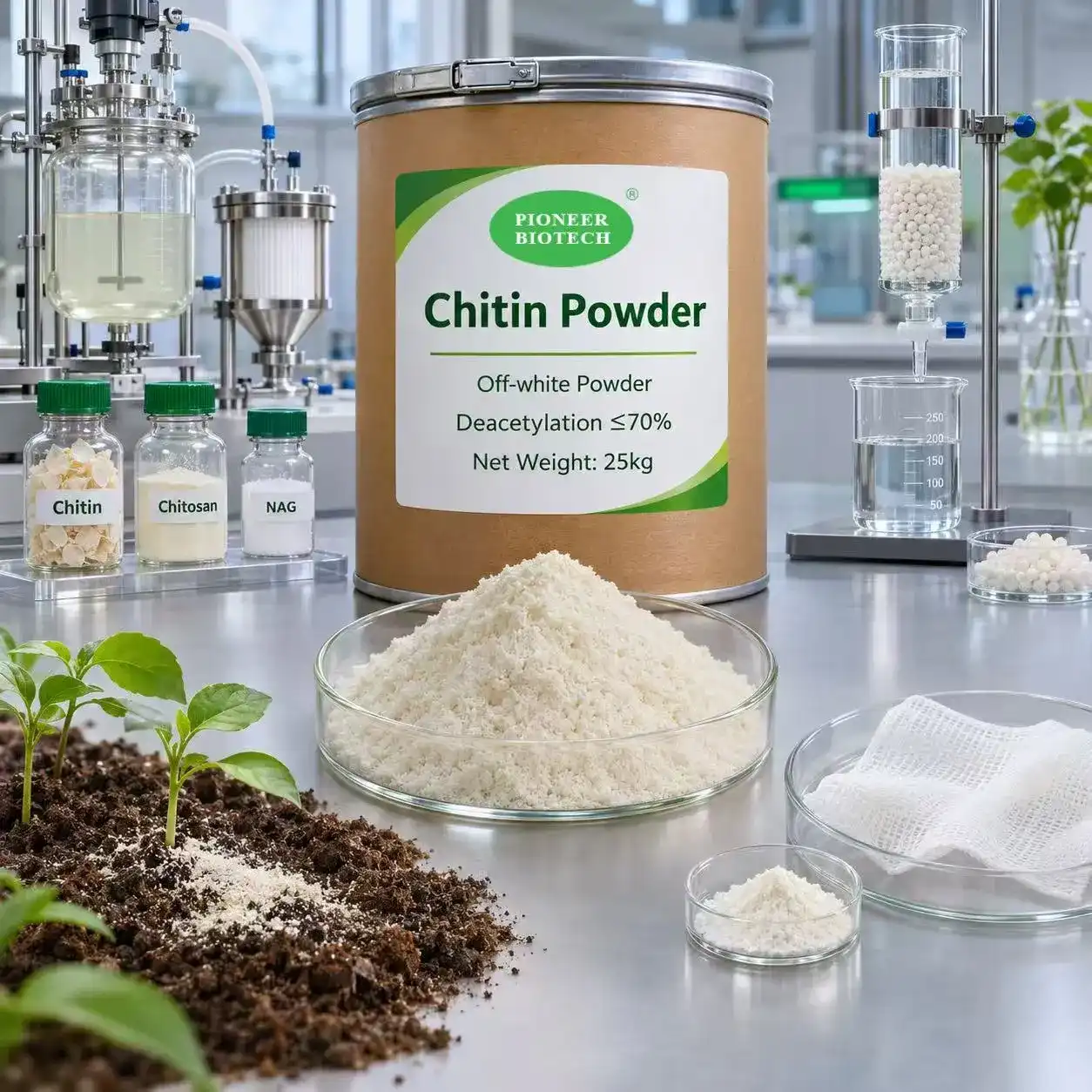
What Is Chitin Powder and Where Does It Come From?
The trip of chitin powder begins in places that most people don't think of: the shells of prawns and crabs, and the walls of fungi. It is a high-molecular-weight carbohydrate in terms of its structure. Its N-acetyl-D-glucosamine units repeat and form α-chitin, a hard, crystalline structure. It has great tensile strength and chemical safety because of this structure.
About 6–8 million metric tonnes of crustacean shells are made every year from seafood waste around the world. A big chunk of that stuff is used as the raw material for extracting chitin. Not only is the ingredient good for the environment, but it also fits with the ideas of the cycle economy.
There are three steps in the extraction process: demineralisation (getting rid of calcium carbonate), deproteinisation (getting rid of crustacean proteins), and decolorisation. The final purity and ash content of the powder are affected by each step. A batch that has been properly demineralised has an ash content of less than 1%, which means it is high-quality material that can be used upstream in pharmaceuticals or nutraceuticals.
Chitin made from fungi is also becoming more popular. It comes from the cell walls of species like Aspergillus niger and is a vegan-friendly option that doesn't contain any allergens. This is very important for brands in the US that want to reach health-conscious or allergy-conscious customers.
It's important to make this clear right away: chitin and chitosan are not the same thing. The Degree of Acetylation of chitin is above 90%, which means it can't dissolve in water. Chitosan is made by partly deacetylating chitin. This makes a water-soluble version that can be used in more direct formulations. Chitosan is the end product of chitin, which is the acetylated precursor.
Core Properties That Define Its Industrial Value
Buying teams and formulators can make better decisions about where to get chitin powder if they know about its technical features.
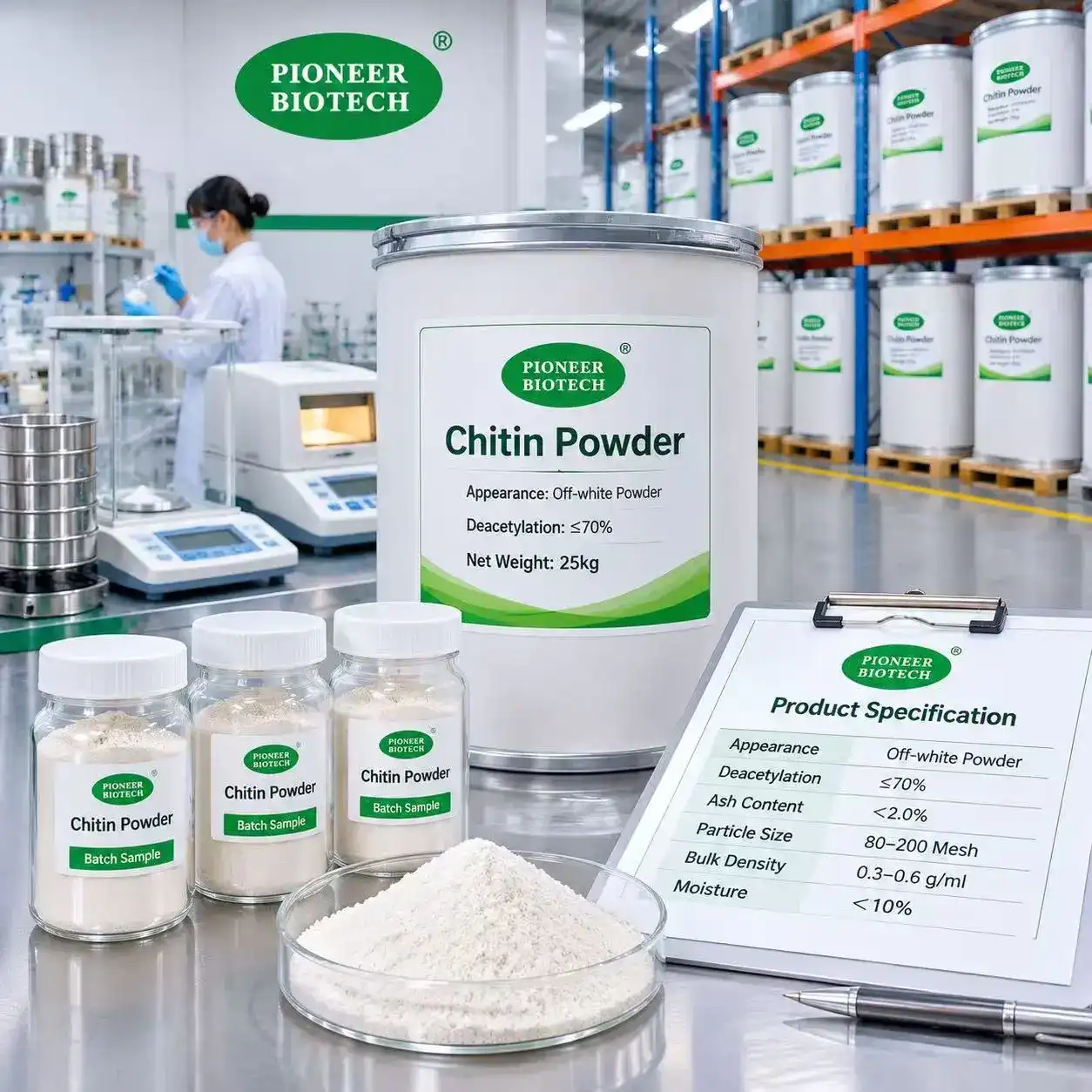
The powder has an off-white to beige colour and flows freely. Having the same colour in different batches is a sign of clean processing.
Degree of Acetylation (DA): This is usually more than 90%. If the DA number is low, it means that the material is changing into chitosan, which changes how it dissolves and reacts.
Size of Particles: There are grades with 80, 100, and 200 mesh. The surface area per gram goes up as the mesh size gets smaller. This greatly speeds up the rate of acid breakdown when glucosamine is being made.
There should be less than 1% ash in high-purity grades and less than 2% ash in industrial grades. Ashes show the calcium carbonate that is still there after minerals are removed. A lot of ash can hurt equipment used later on and lower the amount of hydrolysis that can be done.
Density in bulk: 0.3 to 0.6 g/mL. This range changes how bulk items are packed and how much freight costs.
The amount of moisture was kept below 10%. Moisture is the main thing that can make shelves unstable. Microbes can grow when there is too much moisture in the air during storing.
Chitin powder stays stable for three to five years if it is kept in a cool, dry place and the right amount of moisture is controlled.
When these numbers are exceeded, chitin naturally stops the growth of certain pathogens. It is biocompatible, which means that it doesn't cause defence systems to reject it. These features aren't just there by chance; they directly affect how well it works in research on drug delivery, wound healing materials, and antimicrobial coatings.
Chitin is also strong because it has a crystalline structure. It has been looked at as a part of biodegradable bioplastic films and sustainable packaging materials, with the goal of replacing manufactured polymers.
Key Applications Across Industries
Chitin powder is used in many fields at the same time. Its different parts are used in different sectors.
Chitin powder is an important upstream raw material for the manufacturing of nutraceuticals. It is the main thing that is used to make N-acetyl-D-glucosamine and glucosamine hydrochloride or sulphate by breaking down acids. Glucosamine is an important part of supplements for joint health. More pure chitin directly leads to more hydrolysis yields and a cleaner profile of impurities in the end supplement. This upstream purity relationship is a must for product development directors who are in charge of COA specifications.
Applications in Medicine: Chitin nanoparticles have shown promise as drug delivery vehicles in pharmaceutical research and development. Because they are biodegradable and don't harm living things, they are good for controlled-release systems. Chitin-based wound healing matrices for tissue regeneration have also been studied by researchers. The antimicrobial qualities of the material make them even better at protecting against infection.
Personal Care and Cosmetics: Scrubs and exfoliants that contain synthetic microplastics are no longer used by the cosmetics business. Biodegradable and safe for marine life, chitin-based microbeads are an option. Because it can form a film, chitin is also useful in hair care and skin care products that want to keep wetness in and act as a barrier.
Agriculture and Soil Improvement: Chitin powder works as a biocontrol agent when mixed with soil. It encourages microorganisms in the soil to make chitinase enzymes. Without the use of man-made chemicals, these enzymes break down the cell walls of harmful fungi and nematode eggs. This makes chitin a useful part of plans for organic and regenerative farming.
Textile and Paper Processing: The microfibrillar structure of chitin makes wet paper stronger and helps textile dyes stick better. It takes the place of heavy metal fixatives that are harmful to the environment, which is in line with stricter rules on industry wastewater.
Chitin powder is a non-toxic chelating agent that works well to bind heavy metals in industrial wastewater for water treatment. It's a safe alternative to synthetic precipitants that breaks down naturally, which helps meet environmental standards.
Quality Control Parameters Every Buyer Should Verify
When procurement teams buy chitin powder without a structured quality verification process, they take a big risk. Here are the checkpoints that can't be changed.
Analysis of the Ash Content: Testing at about 600°C for combustion shows that calcium carbonate is still present. Batches with a lot of ash show that the demineralisation process isn't finished. This makes abrasive particles that get into equipment further down the line.
Protein Residue via Kjeldahl Nitrogen Assay: Tropomyosin, a known allergen, gets into the supply chain through crustacean protein that is still there. Any nitrogen content higher than the theoretical nitrogen content of pure chitin means that proteins have been added, which can lead to problems with allergen labelling.
Testing for Moisture: Gravimetric loss-on-drying methods show that the amount of moisture stays below 10%. Batches with more water need to be stored or thrown away right away to fix the problem.
Heavy Metals and Arsenic via ICP-MS: Materials from the ocean concentrate environmental pollutants. For human-adjacent uses, lead levels must be below 2 ppm and arsenic levels must be below 1 ppm, based on well-known food and drug standards.
Viscosity and Molecular Weight: Consistency in viscosity from batch to batch makes sure that glucosamine makers can predict how the product will break down. When there is a lot of difference between batches, it means that the supplier isn't getting or processing the raw materials consistently.
These rules are not just formalities for the government. They protect the safety of the product, the yield down the line, and the brand's liability.
Chitin Powder vs. Chitosan: Understanding the Distinction
People who are buying often get chitin and chitosan mixed up, which has real effects on procurement.
There is more than 90% acetylation in chitin. It doesn't mix with water, weak acids, or most organic liquids. Soluble systems like dimethylacetamide with 5% lithium chloride or hexafluoro-2-propanol are needed to break down chitin for specific uses. It can't be directly used in liquid formulations because it doesn't dissolve.
Chitosan is easily dissolved in watery acetic acid because it is made by deacetylating chitin above 50% DD, which is usually 85% or higher. Because it dissolves easily, it can be used for encapsulation, layer formation, and direct antimicrobial coatings.
It's a simple business relationship: chitin is the raw material and chitosan is the finished product. When people buy chitin, they usually want it to be broken down into glucosamine, used as a structural additive, or processed chemically further. Chosen buyers want an ingredient that is ready to be mixed with other ingredients.
By knowing this difference, you can avoid making costly mistakes when sourcing.
Conclusion
Chitin powder is a natural polysaccharide that can be used in many different ways. It has a lot of promise in the fields of medicine, cosmetics, agriculture, textiles, and water treatment. It is a useful raw material for sustainable manufacturing and product development because it is biocompatible, biodegradable, and strong. To choose the right grade, B2B buying teams need to know the difference between chitin and chitosan and check the purity, ash content, moisture, residual protein, and heavy metal levels. Checking the consistency of batches and carefully evaluating suppliers are important for making sure that processing is reliable, that products are of good quality, and that they meet the needs of each application.
FAQ
What is the primary difference between chitin powder and chitosan powder?
The Degree of Deacetylation is what makes the difference. Chitin doesn't dissolve in water because its Degree of Acetylation is higher than 90%. Chitosan is made when a substance is partially deacetylated above 50% DD. This makes it soluble in weak acids. Chitin is the starting material, and chitosan is the chemically changed product.
Is it safe to use chitin powder in nutraceuticals and things that are close to food?
Chitin is biocompatible and generally thought to be safe by most regulatory bodies, but material from crustaceans needs to be closely monitored for allergens. Protein assays must be used to confirm that tropomyosin has been removed before it can be used for human eating. Chitin from fungi gets rid of all worries about crustacean allergens and works well with vegan product lines.
How does the size of the mesh affect how well chitin powder works in making glucosamine?
When you compare 200 mesh to 80 mesh, for example, you can see that 200 mesh has a lot more surface area per gram of material. This speeds up the acid hydrolysis reaction, lowers the processing time, and raises the output of glucosamine. Choosing the right mesh size is a straight way to improve the efficiency of production.
Partner With Pioneer Biotech for Reliable Chitin Powder Supply
Pioneer Biotech has manufactured and supplied high-purity botanical and marine-derived ingredients since 2012. Our GMP-compliant facility in Hanzhong, Shaanxi — the "Medicine Herbs Valley of Qinling Mountains" — holds ISO9001, HALAL, KOSHER, and FDA qualifications. As a trusted chitin powder supplier, we provide fully documented batches with COA, heavy metal testing, and allergen control reports. Reach our team directly at sales@pioneerbiotech.com to request specifications or samples.
References
1. Rinaudo, M. (2006). Chitin and chitosan: Properties and applications. Progress in Polymer Science, 31(7), 603–632.
2. Muzzarelli, R. A. A. (1977). Chitin. Pergamon Press, Oxford, UK.
3. Pillai, C. K. S., Paul, W., & Sharma, C. P. (2009). Chitin and chitosan polymers: Chemistry, solubility and fiber formation. Progress in Polymer Science, 34(7), 641–678.
4. Dutta, P. K., Dutta, J., & Tripathi, V. S. (2004). Chitin and chitosan: Chemistry, properties and applications. Journal of Scientific & Industrial Research, 63(1), 20–31.
5. Elieh-Ali-Komi, D., & Hamblin, M. R. (2016). Chitin and its effects on inflammatory and immune responses. Clinical Reviews in Allergy & Immunology, 51(1), 85–99.
6. Tharanathan, R. N., & Kittur, F. S. (2003). Chitin — the undisputed biomolecule of great potential. Critical Reviews in Food Science and Nutrition, 43(1), 61–87.