

How to Incorporate Yeast Extract Powder into Your Cooking for Enhanced Flavor
Yeast extract powder is one of the most flexible umami boosters available to food producers today. Made by autolysis or enzymatic hydrolysis of Saccharomyces cerevisiae, it offers a concentrated savoury depth that enhances soups, sauces, spices and snack coatings, with no artificial ingredients. For R&D teams and procurement managers dealing with clean-label standards and sodium-reduction targets, the proper incorporation of this ingredient—at the right dosage, in the right matrix—is a technical and strategic decision. This manual will lead you through everything you need to know to make that decision with confidence.
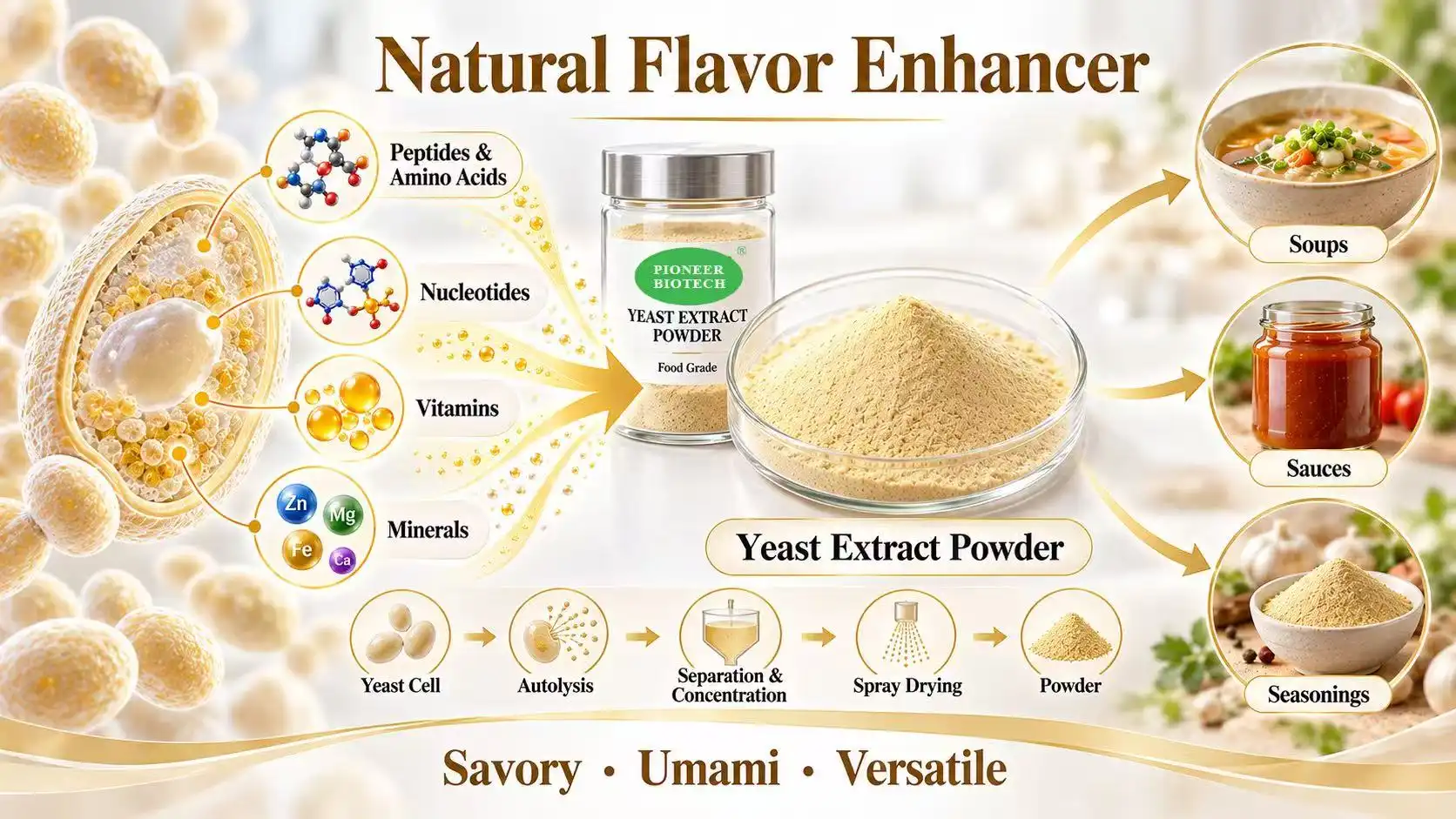
Understanding Yeast Extract Powder and Its Culinary Benefits
What Makes It Functionally Unique
Unlike whole-cell nutritional yeast, yeast extract powder contains only the soluble components inside the cells. This includes free amino acids (mostly glutamic acid), nucleotides (IMP and GMP), peptides, B-vitamins and trace minerals. This targeted profile provides a significant umami intensity due to the well known IMP/GMP additive action with glutamate. This can boost the impression of savouriness up to eight times as much as glutamate alone (Yamaguchi & Ninomiya, 2000). Pioneer Biotech’s standard will provide you a minimum of 60% protein and a minimum of 15% free amino acids. That makes it one of the most nutrient packed tasting substrates you can buy in bulk.
Clean-Label and Allergen Positioning
Consumers' demands for clear labels have changed how things are bought all over North America. Yeast extract powder doesn't have an E-number in the EU, and the FDA considers it a flavoring ingredient, not an additive. This means that it can support claims like "No MSG Added" and "No Artificial Flavors" on the front of the package. Pioneer Biotech's product is Non-GMO, HALAL, KOSHER, and allergen-free when made from molasses-based fermentation substrates. This gives formulation teams the proof they need to back up claims of clean labels.
How to Use Yeast Extract Powder Effectively in Cooking
Dosage and Application Matrix
It is very important to get the dosage right. Overusing hydrolyzed yeast extract powder doesn't make savory notes stronger; instead, it adds a noticeable yeasty top note that messes up the intended flavor profile. In industrial settings, the useful range is between 0.2% and 2.0% of the total weight of the product, with 0.5% to 1% usually giving the best results. Here are the main uses for this ingredient that it consistently works best in:
- Soups and retort pouches: When added at 0.8% to 1.2%, it works as a kokumi enhancer, giving the mouthfeel thickness and flavor continuity that stops the thin, watery feeling that often comes with low-sodium recipes. Because it is thermally stable, it can be sterilized in a UHT or retort without losing any of its taste.
- Snack seasonings and coatings: In potato chip mixes and extruded snacks, 0.5% to 1% drives Maillard reaction intermediates during extrusion, creating roasted meat-like aromatic compounds that taste like animal fat. This is especially helpful for making plant-based snacks.
- Compound seasonings and bouillon: Adding yeast extract powder to spice blends instead of 20% to 25% of sodium chloride keeps the spices' saltiness while lowering the amount of sodium they contain, which directly supports FDA-approved sodium reduction goals.
These groups are not made up; they come from pilot studies of real-life corporate flavor creation projects. Before setting final inclusion rates, R&D teams should use their current MSG or HVP standard to do open panel evaluations.
The right way to store something is just as important as keeping it functional. For the powder to stay useful, it needs to be kept in multi-wall kraft bags with plastic covers that are sealed and have a relative humidity below 60%. As soon as the package is opened, it needs to be resealed under pressure to stop caking, which can affect the accuracy of automatic dosing on production lines.
Comparing Yeast Extract Powder to Alternative Flavor Enhancers
Head-to-Head: Yeast Extract vs. MSG, HVP, and Soy Sauce
When procurement workers look at flavor enhancer choices, they have to choose between regulatory freedom, taste complexity, and cost-effectiveness. MSG gives you pure glutamate intensity, but it's hard to label and people have trouble understanding what it means. Hydrolyzed vegetable protein (HVP) has a wide range of amino acids, but depending on the source substrate, it may need to be labeled as an allergen. Soy sauce adds umami along with sodium and color, which can be a problem when making white sauce or pale soup.
There is a special place in formulation for yeast extract powder because it gives flavors a lot of different levels of complexity by working with glutamate, IMP, GMP, and kokumi-active peptides. When it comes to taste, high-nucleotide grades (I+G content >10%) are the most similar to MSG functionally, but they are easier to regulate and sell. Manufacturers who make goods with promises of "Zero Added MSG" should not see this as a compromise, but as a strategic move forward.
Selecting the Right Yeast Extract Powder Supplier for B2B Purchasing
Evaluation Criteria That Actually Matter
In this category, choosing a supplier is more complicated than just comparing prices per ton. Flavor consistency from batch to batch is probably the most important factor. If flavors change between production lots, customers will complain more than any savings in costs. When looking for a hydrolyzed yeast extract provider, the following traits show if the partnership will work in the long term:
- Certified quality infrastructure: ISO9001 approval, FDA registration, and microbial tests by a third party are the bare minimum. Along with HALAL and KOSHER approval and a PCT patent on its extraction process, Pioneer Biotech has all three.
- Application support and customization: Suppliers that offer CRO/CMO/CDMO services, such as pilot-scale formulation trials and clinical study support, can help you with your own research and development (R&D) and get new product lines to market faster.
- Supply chain reliability: ready stock in foreign stores, clear wait times, and open account terms are all practical factors that affect production schedules just as much as flavor performance.
Pioneer Biotech keeps ready-to-use stock in warehouses overseas and helps with plant audits, third-party testing, and all the papers needed to meet U.S. legal requirements. For a blind taste test before committing to a larger order, gift samples are available.
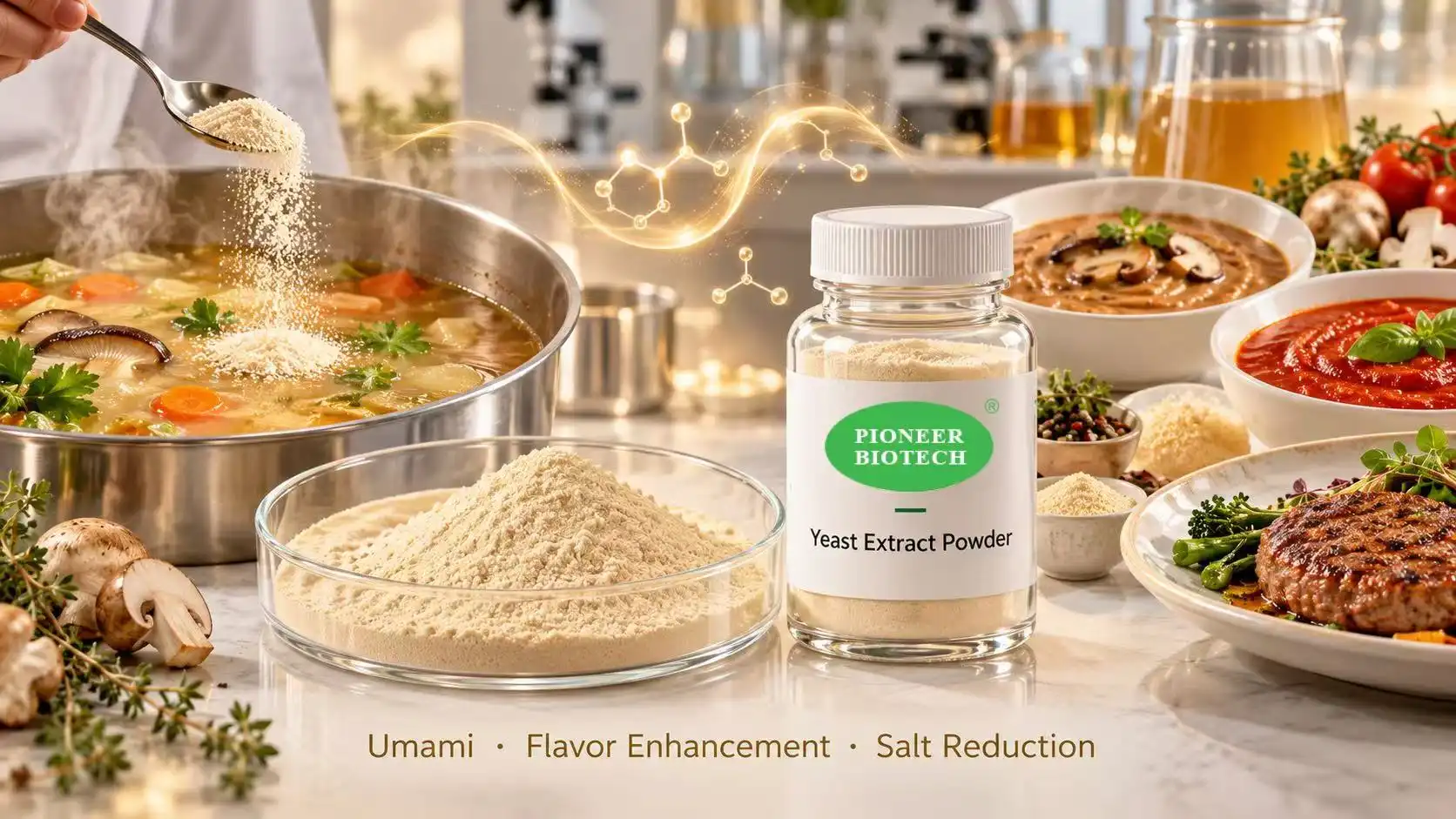
Maximizing Business Value with Yeast Extract Powder Integration
Strategic ROI Beyond Flavor
Adding yeast extract powder has business benefits that go beyond taste. Nielsen (2019) says that clean-label goods regularly command a price premium of 5% to 10% at retail, and claims that a product has less sodium are now one of the top five reasons health-conscious U.S. buyers buy something. Adding a natural umami substrate that lets you make claims like "No MSG," "Reduced Sodium," and "Non-GMO" all at the same time combines three different marketing investments into one ingredient choice.
From the point of view of the supply chain, bulk pricing models for yearly contracts with big volumes make the economics of production much better. Pioneer Biotech has a competitive pricing model and always delivers products that meet the specifications (protein ≥60%, pH 5.5–6.5, and moisture ≤5%). This makes it easy for procurement teams to predict accurately how much ingredients will cost across multiple quarters of production.
Conclusion
Yeast extract powder isn't just an ingredient for flavor; it's also a way to make things. When used properly, it lets companies lower the amount of salt in their products, get rid of MSG, improve their nutritional labeling, and give them the complex, savory depth that customers know and love. The important thing is to find a provider whose infrastructure, application knowledge, and supply stability meet the needs of large-scale production. Pioneer Biotech has been building that infrastructure since 2012, and we are ready to show it off with samples, surveys, and side-by-side taste tests.
FAQ
1. Is yeast extract powder the same as MSG?
Not at all. MSG is pure monosodium glutamate that has been frozen. Amino acids, nucleotides, peptides, vitamins, and minerals are all present in yeast extract powder, a complex ingredient. It has naturally occurring glutamic acid but is not an additive because it is a food ingredient. It also backs up claims on the "No Added MSG" label.
2. Can it replace MSG on a 1:1 basis in formulations?
Not quite by weight. The most functionally similar types are high-nucleotide (I+G) grades. Inclusion rates are usually between 0.5% and 2.0%, which is higher than MSG's lower usage levels. However, the flavor diversity that results often beats MSG-only standards.
3. Is it gluten-free?
Yeast extract powder from Pioneer Biotech is naturally gluten-free because it is made from fermentation of sugar. If a finished product says it is gluten-free, you should always ask for proof of the substrate.
4. How should bulk quantities be stored?
Keep in multi-wall paper bags that are sealed and lined with plastic at a relative humidity below 60%. Caking doesn't make things less safe, but it makes automatic production systems less accurate at dose. Once the bag is open, it should be quickly resealed under vacuum.
5. Is third-party testing available?
Yes, Pioneer Biotech allows third-party lab proof and gives full paperwork, such as COAs, MSDSs, allergen statements, and non-GMO certificates.
Partner with Pioneer Biotech — Yeast Extract Powder Supplier for Industrial Food Manufacturers
Pioneer Biotech offers yeast extract powder that is safe for use in pharmaceuticals. It has at least 60% protein, uniform IMP/GMP nucleotide profiles, and full clean-label paperwork. Our FDA-registered and ISO9001-certified center helps with plant audits, working together with CROs, CMOs, and CDMOs, and getting ready-to-ship goods from foreign warehouses. You can ask for your evaluation sample right now and compare it directly and anonymously to your current standard. To start the buying process, email our expert team at sales@pioneerbiotech.com or go to pioneerbioinc.com.
References
1. Yamaguchi, S., & Ninomiya, K. (2000). Umami and food palatability. Journal of Nutrition, 130(4), 921S–926S.
2. Nielsen. (2019). The Future of Food: Evolving Consumer Preferences and Clean Label Trends. Nielsen Global Connect.
3. Mouritsen, O. G., & Styrbæk, K. (2014). Umami: Unlocking the Secrets of the Fifth Taste. Columbia University Press.
4. Food Chemicals Codex. (2022). Yeast Extract Monograph. United States Pharmacopeia.
5. Kuroda, M., & Miyamura, N. (2015). Mechanism of the Kokumi Taste Perception and Its Application in Food Products. Flavour, 4(1), 1–7.
6. U.S. Food and Drug Administration. (2023). Guidance for Industry: Voluntary Sodium Reduction Goals — Target Mean and Upper Bound Concentrations for Sodium in Commercially Processed, Packaged, and Prepared Foods. FDA.