

Do You Know What Hydrolyzed Keratin Is?
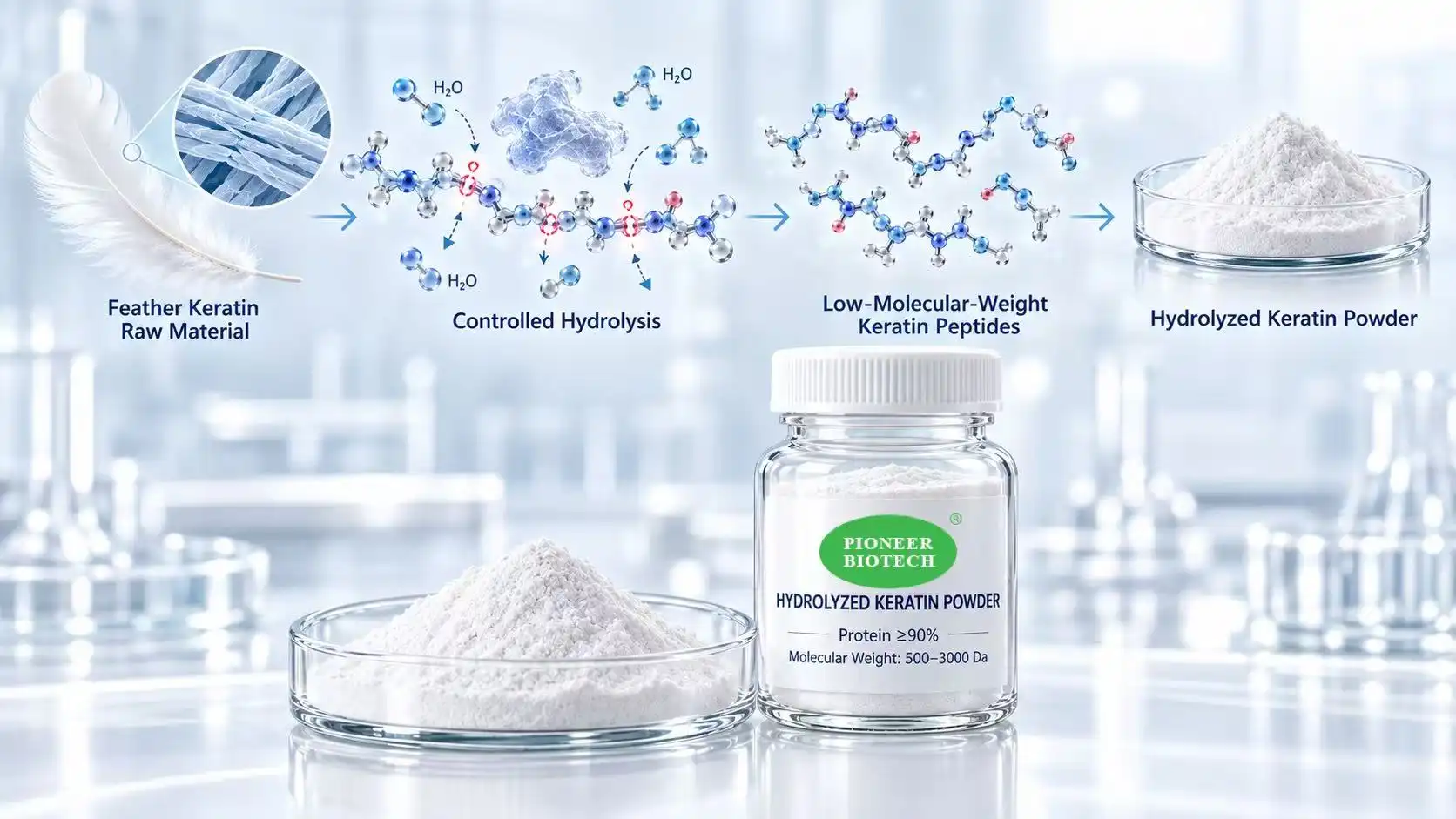
Hydrolysed keratin has emerged as one of the most sought after functional proteins in personal care, nutraceutical and pharmaceutical formulations. In simple terms, keratin protein powder is a water soluble protein. It is obtained from biological sources containing high amounts of keratin, such as chicken or duck feathers, which are hydrolysed in a controlled manner (enzymatic or chemical) into smaller peptide fragments with molecular weights between 500 and 3,000 Daltons. This molecular reduction converts a usually insoluble structural protein to a highly accessible substance capable of permeating the hair shaft, skin surface and nail plate with detectable effectiveness.
What Is Pure Hydrolyzed Keratin?
The Science Behind Keratin Hydrolysis
Native keratin is a protein, hard and not soluble in water, which is the fundamental building block of hair, nails and the top layer of the skin. It is challenging to process . It has a strong , crosslinked structure kept together by disulphide linkages between cysteine residues . Hydrolysis deliberately breaks these bonds . The resulting peptide chains are now soluble but have retained their original amino acid profile , including the greater cysteine concentration . Therefore, keratin hydrolysates are different from other vegetable proteins such as wheat or soy.
Why Molecular Weight Determines Performance
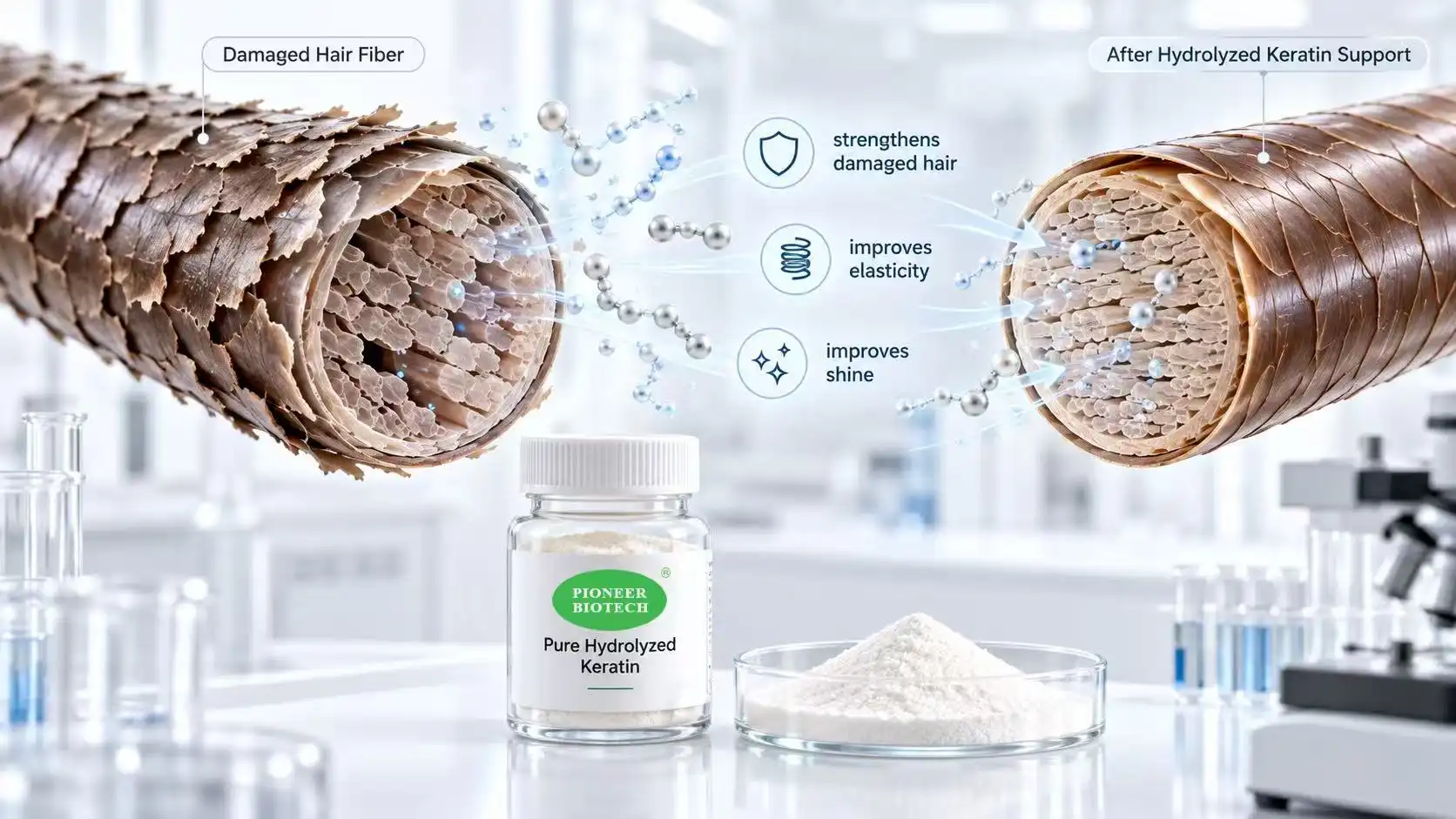
How hydrolyzed keratin works depends a lot on the size of the peptides. Small pieces (less than 1,000 Daltons) can get into the cortex of chemically damaged hair fibers and fix the hydrogen and ionic bonds that were broken when the hair was bleached or styled with heat. Larger pieces (1,000–3,000 Daltons) stick together and form a film over the cuticle surface. This makes the surface less porous and more reflective of light, which can be seen by checking the standard tensile strength and gloss. Pioneer Biotech's product has a molecular weight range of 500–3,000 Daltons and a protein makeup of at least 90%. This gives formulators exact control over the ratio of penetrating to film-forming.
Hydrolyzed Keratin vs. Related Proteins: A B2B Comparison Guide
Structural Differentiation That Affects Formulation Outcomes
A lot of the time, procurement teams look at hydrolyzed keratin with collagen, silk amino acids, and wheat protein. Each one gives a different biochemical profile. Collagen hydrolysates have a lot of hydroxyproline but not much cysteine, which makes it harder for keratin protein powder to bind to hair keratin structurally. Silk proteins are good at making films, but they're not very good at fixing the cortex. Wheat protein hydrolysates are cheap and easy to find, but their amino acid structure is very different from human keratin, which means they work on the surface instead of repairing cells.
Pure hydrolyzed keratin is the only substance that has the exact same amino acid structure as human hair. It can re-form disulfide-like bonds in broken fiber zones because it has a lot of cysteine. This is something that neither collagen nor plant proteins can do. This specificity directly means better performance for R&D teams working on post-bleach rebuilding systems or professional smoother treatments, as well as a more believable ingredient story on product labels.
How to Effectively Use Hydrolyzed Keratin in Hair Repair and Cosmetic Formulations
Recommended Concentration and Compatibility Guidelines
It is easy to add hydrolyzed keratin to water-based mixtures because it dissolves easily in water. The usual range for successful usage levels is between 0.5% and 5% by weight. Below 0.5%, the repair benefit is almost nonexistent. Above 5%, the risk of protein overload—shown as stiffness or less elasticity—increases, especially in hair that is fine or doesn't have many pores.
Here are the most important equation factors for a smooth integration:
- Shampoos and rinse-off conditioners: A quantity of 0.5% to 2% makes hair easier to comb and smooths the surface without leaving behind any residue because the extra protein rinses off easily.
- Leave-in serums and bond-builder treatments: A concentration of 2% to 5% is fine. When the peptides are activated by heat (blow-drying at 150–200°C), they form a brief protective structure that keeps chemically-tired hair from breaking.
- Skincare moisturizers and barrier creams: At 1%–3%, keratin peptides form a thick film that significantly lowers trans-epidermal water loss (TEWL). This helps the barrier repair process without blocking it.
In these factors, you can see how widely hydrolyzed keratin can be used to make a difference. For formulation to work, it needs to be paired with humectants and pH-buffering agents that are suitable. Pioneer Biotech's expert team can help you make a compatibility map for your matrix.
Procurement Insights: How to Source Hydrolyzed Keratin for Your Business
Quality Signals That Separate Reliable Suppliers from Unreliable Ones
Specification sheets are not enough to find large amounts of keratin protein powder. When evaluating a supplier carefully, the following points should be checked:
- Molecular weight distribution (GPC/SEC analysis): A non-uniform peptide size distribution means that the hydrolysis process is not well controlled and there is variation from batch to batch, which will lower the performance of the final product.
- Amino acid profile (HPLC): Cystine/cysteine proof tells the real keratin hydrolysates from cheaper ones. A drop in cystine levels could mean that the protein has been tampered with or over-hydrolyzed, which breaks down important amino acids.
- Heavy metals and microbial load: Getting food from animals that have been killed poses a bioaccumulation risk. In order to make sure that the total plate count meets USP <61> standards (<100 CFU/g), lead levels must be below 10 ppm and arsenic must be below 2 ppm.
- Odor assessment: Uncompleted hydrolysis leaves behind sulfurous volatiles that mess up scent systems. Before you approve any batch, you should ask for data from organoleptic testing.
Pioneer Biotech has an ISO9001 certification, a manufacturing facility that is registered with the US Food and Drug Administration (FDA), and a PCT patent on its hydrolysis process. If you ask, you can get third-party testing, plant audits, and help with clinical studies. Ready stock is kept in warehouses overseas so that orders can be sent quickly to the US market, and CRO, CMO, and CDMO partnerships are welcome for clients who need special development paths.
Conclusion
In conclusion, when it comes to protein ingredients, pure hydrolyzed keratin is one of a kind because it has a biomimetic attraction for human hair and skin that other protein ingredients from plants can't match. The choice of where to get this ingredient comes down to clinical reliability and end-user trust for procurement workers, R&D formulators, and product development leaders. If you want to run a real formulation program, you have to choose a supplier that has regulatory paperwork, molecular weight control that has been checked, and clear amino acid profiling. These standards are met by Pioneer Biotech, and the company is happy to show it.
FAQs About Pure Hydrolyzed Keratin
1. Is hydrolysed keratin safe for sensitive skin?
Keratin peptides that have been broken down by enzymes have a well-established safety profile. Since the protein has been broken up into small pieces, most of the complete allergic epitopes have been removed. For skin types that are very sensitive, patch testing is still recommended. However, hydrolyzed keratin is generally accepted in clean-beauty products, as long as it is broken down by enzymes and any preservatives used in liquid forms are free of parabens.
2. How is it different from regular keratin?
Native keratin doesn't dissolve in water, so it can't be used in cosmetic systems that use water. Hydrolyzed keratin dissolves in water, is amphoteric, and substantive, which means it links to damaged areas on the skin and hair instead of just sitting on the surface.
3. How can I verify quality before placing a bulk order?
Ask for a certificate of analysis (COA) that lists the amount of protein, the range of molecular weights, the maximum amount of heavy metals, and the number of microbes. Before placing a full order, make sure you get proof from a third-party lab and, if you can, do your own GPC study.
4. What is the shelf life?
When stored in a cool, dry place, powder form stays stable for up to 24 months. Liquid formulations can usually be kept for 12 months if they are stored properly.
Partner with Pioneer Biotech — Trusted Hydrolyzed Keratin Supplier for the US Market
Trust Pioneer Biotech as your trusted source for hydrolyzed keratin in the US market. Since 2012, Pioneer Biotech has been making standard bioactive ingredients in a 7,000 m²+ GMP-aligned facility in Hanzhong, China. The facility is certified by ISO9001, HALAL, KOSHER, and the FDA. As a verified supplier of pure hydrolyzed keratin, we offer a protein content of at least 90%, a flexible minimum order quantity, free samples, and full help with paperwork for US regulatory submissions. For more information, you can email our expert sales team at sales@pioneerbiotech.com or visit pioneerbioinc.com to see all of our ingredients.
References
1. Hearle, J. W. S. (2000). A critical review of the structural mechanics of wool and hair fibres. International Journal of Biological Macromolecules.
2. Rouse, J. G., & Van Dyke, M. E. (2010). A review of keratin-based biomaterials for biomedical applications. Materials.
3. Shavandi, A., Silva, T. H., Bekhit, A. A., & Bekhit, A. E.-D. A. (2017). Keratin: dissolution, extraction and biomedical application. Biomaterials Science.
4. Reichl, S. (2009). Films based on human hair keratin as substrates for cell culture and tissue engineering. Biomaterials.
5. Coderch, L., López, O., de la Maza, A., & Parra, J. L. (2003). Ceramides and skin function. American Journal of Clinical Dermatology (cited for keratin-barrier interaction context).
6. Martínez-Maqueda, D., miralles, B., & Recio, I. (2015). HT29 cell line in food hydrolysate research. Journal of Agricultural and Food Chemistry (cited for peptide bioavailability methodology).