

Determining the Quality and Identity of Valerian Root Extracts
To figure out the quality and identity of valerian root products, they need to be put through strict scientific tests and have their suppliers checked out thoroughly. When buying valerian root extract powder for commercial use, buyers must set clear standards that include standardized valerenic acid content, no added substances, and proof of compliance with international drug standards. The difference between ratio extracts and standardized extracts has a big effect on the consistency of the formulation. Standardized grades offer assured bioactive amounts that ratio standards alone can't provide. HPLC analysis, heavy metal screening with ICP-MS, and microbial testing that meets legal standards in the pharmaceutical, nutritional, and skincare markets are all used in the verification process.


Understanding Valerian Root Extract Powder: Quality & Identity Basics
The Botanical Foundation and Active Constituents
Valeriana officinalis is the plant that valerian root extract powder comes from. It has a complicated matrix of sesquiterpenes, especially valerenic acid, valepotriates, and isovaleric acid, which determine its medicinal effectiveness and authenticity. Controlled hydro-alcoholic extraction, usually using ethanol-water ratios between 50:50 and 70:30 to balance lipophilic and hydrophilic components, is how high-quality extracts keep these delicate chemicals safe. Pioneer Biotech's production experience has taught us that the temperature and length of the extraction process have a big effect on how well volatile terpenes are preserved and how well sensitive valepotriates are kept from breaking down. The smell, which most people find unpleasant, comes from isovaleric acid formation and, strangely enough, is a sign of authenticity rather than a quality problem.
Extract Types and Standardization Approaches
Knowing the main difference between ratio extracts and standardized extracts keeps buyers from getting confused and makes sure that formulations are always accurate. A 10:1 ratio extract means that 10 kg of raw root material made 1 kg of finished powder, but this concentration number doesn't say anything about the biological content. On the other hand, standardized extracts list the amounts of valerenic acid they contain, which are usually 0.4%, 0.8%, or more. This makes it possible for the biological effects to be consistent across production runs. Pharmaceutical and supplement companies are asking for standardization certificates more and more because clinical study shows that specific valerenic acid doses are better at predicting therapeutic results than general concentration ratios.
Common Quality Challenges in Valerian Procurement
There is still a risk of adulteration in the valerian supply chain, as dishonest sellers mix cheaper plants or synthetic compounds to make them look like the desired chemical profiles. Different farming methods, harvest times, and treatment after harvest all have an effect on secondary metabolite amounts, which can lead to differences in purity. Organic approval adds to the complexity because organic farming may produce lower amounts of valerenic acid than normal farming. This means that buyers have to balance their desire for a clean label with their need for potency. Powder stability is affected by changes in moisture content. Hygroscopic extracts easily take water from the air, which helps microbes grow and causes clumps during storage and production.
Core Criteria and Methods to Verify Valerian Root Extract Powder Quality
Essential Physicochemical Parameters
Professional buying specs need to spell out exact physicochemical properties that make sure the products can be manufactured together and always work the same way. We suggest setting the following standards as a starting point for judging the quality of valerian root extract powder:
- Particle Size Distribution: At least 95% of the particles must pass through an 80-mesh screen for capsule recipes to blend evenly, and this keeps the particles from separating during high-speed tableting operations. In functional beverage uses where fast dispersion is important, finer particle sizes help with dissolution rates.
- Moisture Content: The goal is to keep the moisture content below 5% so that microbes don't grow and the powder can still move. Valerian products that are hygroscopic need strict moisture control in both storage and production areas, with relative humidity kept below 60%.
- Bulk Density and Flow Characteristics: Measurements of angle of repose less than 40 degrees show that the flow qualities are good enough for automatic encapsulation equipment. When flowability is bad, fill weight changes, which makes dose accuracy in finished goods less reliable.
- Ash Content: Total ash below 5% and acid-insoluble ash below 2% show that there isn't much mineral contamination and that the right methods were used for extraction. High amounts of ash mean that the raw materials were not cleaned well or that there is too much soil waste.
Analytical Methods for Identity and Potency
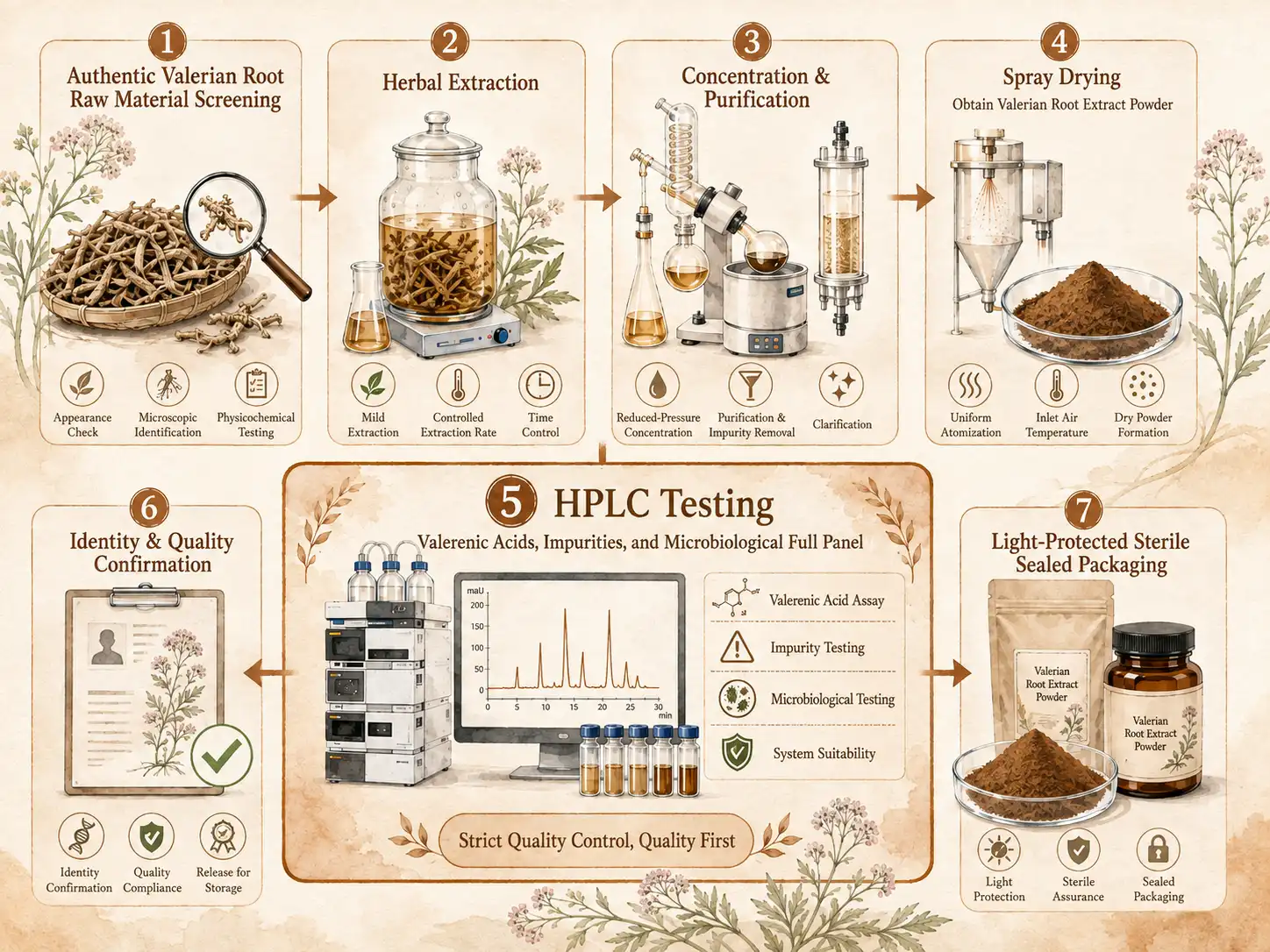
High-performance liquid chromatography is still the best way to measure valerenic acid and find chemical fingerprints. HPLC techniques separate and measure valerenic acid, acetoxyvalerenic acid, and hydroxyvalerenic acid. This creates complete identity profiles that tell the real Valeriana officinalis from fake botanicals. Gas chromatography-mass spectrometry is an additional method for analyzing volatile compounds that can find specific patterns of sesquiterpenes and leftover solvents from extraction. Each batch from a reliable seller comes with a verified HPLC chromatogram that shows peak areas and retention times that match reference standards.
Thin-layer chromatography is a cheap way to do basic screening. It shows unique band patterns under UV light that show the presence of valerenic acid. TLC is not as accurate as HPLC, but it quickly finds obvious signs of fraud and can be used to check big packages before they are accepted. Pioneer Biotech does both HPLC and TLC tests so that our customers in the pharmaceutical and nutraceutical sectors can be sure of two levels of quality.
Safety Testing and Regulatory Compliance
Heavy metal pollution is a big legal risk, especially for goods that are going to be sold in California, where Proposition 65 applies. ICP-MS testing measures lead, cadmium, arsenic, and mercury at a level of parts-per-billion accuracy, making sure that the limits set by international pharmacopeia and FDA advice papers are met. At our factory, each batch of products goes through an ICP-MS test, and records of analysis show that they meet both EU and US heavy metal standards.
Microbial testing includes counting the total number of aerobic plate count, counting yeasts and molds, and looking for pathogens like Salmonella, E. coli, and Staphylococcus aureus. GMP-compliant production needs to keep an eye on the surroundings and use proven sanitation methods to keep microbes from getting into the food while it's being processed and packed. For regular extracts, it's important to look for pesticide residues like organophosphates, carbamates, and synthetic pyrethroids that may cluster during extraction. Multi-residue methods can help with this.
Supplier Audit and Supply Chain Transparency
Quality assurance includes more than just scientific tests. It also includes carefully checking the supply chain and evaluating suppliers. Leading buyers of pharmaceuticals and nutraceuticals do on-site tests that check the traceability of raw materials, the validity of extraction equipment, and the paperwork of batches. At Pioneer Biotech, we keep full records of the botanical sources from our Qinling Mountains cultivation region through the steps of extraction, standardization, and final packing.
Third-party certification programs, such as ISO 9001, HALAL, KOSHER, and organic certifications, make sure that production methods and quality control systems are working properly. Buyers should ask for up-to-date certification papers and use databases maintained by the certifying group to make sure they are real. Our ISO 9001 certification shows that we have quality control built into every step of the manufacturing process, and our FDA registration gives you even more peace of mind about goods that are going to the US.
Comparing Forms and Suppliers: Making an Informed Procurement Decision
Product Format Considerations
Organic valerian root extract powder comes in a number of different forms that are useful for different commercial uses and consumer tastes. Understanding the benefits of each style helps you choose the best materials for your target formulas. Powdered extracts give you the most options for how to make your formulations. They can be used for pill filling, tablet compression, and sachet packing. Standardized powders are more concentrated than less concentrated forms, which makes doses more accurate and shipping cheaper. Standard hydro-alcoholic extracts don't mix well with water, which can cause sediment problems in drinks unless they are made especially for use with water.
Water-soluble grades go through special processing with carrier systems that let them dissolve completely in cold water. This meets the needs of healthy drinks and ready-to-drink vitamins. These changed extracts cost more, but they don't need to be filtered and keep the solution fixed throughout the product's shelf life. Formulators of drinks should be clear about how water-soluble they need to be when they buy ingredients so that they don't have to wait for reformulation.
In gummy and chewable forms, where valerian's strong smell makes them hard to swallow, deodorized products help with taste issues. But harsh deodorization methods might break down volatile medicinal terpenes, which could make them less effective. We suggest using high-barrier softgels or enteric coats for packaging instead of chemical deodorization, which could damage the bioactive structure.
Organic versus Conventional Sourcing
When deciding between organic and standard, you have to weigh the benefits of clean label marketing against concerns about effectiveness and costs. Synthetic pesticides and fertilizers are not allowed in organic valerian cultivation. This makes extracts that natural product buyers like and meet the standards for organic approval for finished goods. However, the yields from organic farming are usually lower than those from standard farming. This is because, based on the soil conditions and farming methods, valerenic acid concentrations may be lower.
Conventional valerian allows for better fertilization and tailored bug control, which may increase the production of secondary metabolites and the uniformity of raw materials. Conventional extracts need to be thoroughly tested for pesticide residues, but they tend to have better potency stability from batch to batch and better price for formulas that need to save money. Pharmaceutical companies often care more about consistency in strength than about being organic, but more and more consumer supplement brands want organic approval even if there are small differences in potency.
Evaluating Manufacturers and Identifying Counterfeits
Checking that the supplier is legally registered as a business, reading customer reviews, and looking into any regulatory warning letters or import violations are the first steps in judging their image. Manufacturers that have been around for a while don't make false promises about impossible standards. Instead, they are open and honest about their production capabilities, wait times, and minimum order quantities.
There is a higher chance of counterfeiting when the market for valerian grows and prices of commodities go up. Prices that seem too low, refusal to provide batch-specific records of analysis, and differences in how the product looks from shipment to shipment are all red flags. Real sellers are happy for third parties to check their work and keep samples that can be used to prove the quality in the past. Before making big purchases, we tell potential buyers to ask for examples and have them analyzed by a third party to make sure the specs given are accurate.
Where Valeriana officinalis comes from affects its quality makeup. For example, Valeriana officinalis grown in Europe has generally different phytochemical ratios than that grown in Asia. If the right farming and manufacturing methods are used, valerian grown in China in places like our Qinling Mountains site can be as good as or better than European valerian. Buyers shouldn't base their decisions on where a provider is located, but on analysis results that have been shown.
Best Practices for Usage, Storage, and Safety of Valerian Root Extract Powder
Dosage Guidelines and Formulation Recommendations
Doses of 300 to 600 milligrams of pure valerian root extract powder have been shown in clinical studies to improve sleep quality. These doses are usually given 30 to 120 minutes before bedtime. Formulations for anxiety relief use similar dosage amounts spread out over several daily doses. These suggestions are based on facts and only work for extracts that are standardized to 0.8% valerenic acids. For ratio extracts, it would take more research to find therapeutic amounts that are the same.
Combination formulas often combine valerian with plants that work well together, like passionflower, lemon balm, and hops, to make sleep last longer and start earlier. When formulators mix different plant extracts, they have to think about how they might react with each other and test the security of the mixture to make sure it stays compatible over time. At Pioneer Biotech, we help with formulations by drawing on our experience making valerian mixes that work well for clients in the nutrition industry all over North America.
Storage Conditions and Shelf Life Optimization
The right way to store things keeps bioactive substances safe and stops physical breakdown that lowers the performance of manufacturing. Valerian root extract powder needs to be kept in containers that are tightly sealed and keep out moisture from the air. Aluminum-laminated bags work better than regular plastic packaging as vapor barriers. To keep things from hygroscopically absorbing water and then caking, storage temperatures should stay below 25 degrees Celsius and relative humidity should be kept below 60%.
Light speeds up the oxidative breakdown of sensitive valepotriates and sesquiterpenes, which is why opaque packing materials and dark places to store them are needed. When stored properly, valerian extracts stay active for 24 to 36 months. Regular testing for valerenic acid during the shelf life time confirms that the extracts are stable. We do rapid stability studies on our extracts and give our clients data to back up the expiration dates and storage directions that are written on the labels.
When weighing and mixing in a production setting, the conditions must be controlled so that the valerian extract doesn't absorb too much water, which can cause problems with flow and sticking. High-speed capsule filling equipment is very sensitive to changes in flow that are caused by moisture. Even small amounts of hygroscopic moisture absorption can cause fill weight differences. Facilities should keep low-humidity production areas separate for hygroscopic plant products.
Safety Profile and Regulatory Considerations
Valerian root extract powder has a usually good safety rating, which is backed up by a lot of traditional use and clinical research. Some common side effects that don't happen very often are mild stomach problems, feeling sleepy in the morning at higher doses, and sometimes feeling too stimulated in sensitive people. Some things that make it not a good idea to use this drug at the same time as sedatives are being pregnant or breastfeeding without professional help, and having surgery planned because of possible anesthetic interactions.
Valerian is regulated differently in different countries. In the US, it is legal as an ingredient in dietary supplements under DSHEA. In Europe, it is listed as a traditional plant medicine, and in Canada, it is regulated as a natural health product. Manufacturers of finished goods must make sure that they follow labeling rules, health claim limits, and good production practices that are specific to their area. Our production plant keeps up-to-date certifications that allow it to access global markets. This lets clients find ingredients that are legal in any regulatory setting they are trying to reach.
Conclusion
Valerian root preparations need to be put through a lot of scientific tests, their suppliers need to be carefully looked at, and there need to be clear standards for specifications that match the intended uses. Standardized extracts with proven valerenic acid content make formulations more consistent than ratio standards, which helps make sure that therapeutic effects are the same from batch to batch. It is possible to find a good mix between the need for potency, safety paperwork, certification, and cost by working with suppliers who are honest and whose quality control has been proven. Using storage methods that keep hygroscopic extracts away from light and moisture helps keep the biological integrity of a product for as long as it lasts and keeps the manufacturing performance characteristics.
FAQ
Why does valerian extract powder have such a strong, unpleasant odor?
The smell comes from isovaleric acid, which is a natural byproduct of valepotriates that is found in real Valeriana officinalis root material. Instead of showing problems with the quality, this unique smell acts as a sign of validity, proving that the plant is real. There are deodorized forms, but they might lose some of the medicinal terpenes that make them volatile through rough processing. We suggest using high-barrier softgels or enteric coats for packaging instead of chemical deodorization, which could lower the bioactive content.
What distinguishes a 10:1 ratio extract from a standardized extract?
Ratio requirements only show the mass relationship between the input of raw materials and the output of final extracts. They don't promise the concentrations of bioactive compounds. A 10:1 ratio means that 10 kg of root made 1 kg of powder, but the amount of valerenic acid is still unknown and can change. Standardized extracts promise certain amounts of marker compounds, usually 0.8% valerenic acids. This ensures consistent biological activity, which helps predict therapeutic effects and makes it possible to make the same formulations for different runs of production.
How can we prevent moisture-related caking during production?
Because valerian root extract powder is hygroscopic, it needs to be kept in an area that is kept below 25 degrees Celsius and the relative humidity below 60%. Use aluminum-laminated containers with tight lids for storage, and keep the contents as close to the air as possible while they are being weighed and mixed. Having dedicated low-humidity production zones helps high-speed sealing equipment that is sensitive to changes in flow. Adding the right anti-caking agents that work with the target formulas gives more security without changing the bioactive content or breaking any rules.
Partner with a Trusted Valerian Root Extract Powder Manufacturer
Pioneer Biotech is an expert at making high-quality valerian root extract powder that meets the strict quality standards needed by North American companies that make medicines, supplements, and cosmetics. Our 7,000-square-meter plant is in the Medicine Herbs Valley of the Qinling Mountains. It has ISO 9001, HALAL, KOSHER, and FDA certifications, which help it comply with world rules. We give full certificates of analysis with every batch. These include measuring valerenic acid using HPLC, testing for heavy metals using ICP-MS, and checking for microbes using microbial screens. Our expert team can help you with formulation, give you stability data, and set custom standardization levels that are perfect for your purpose. Get samples, talk about your project details, and find out why top supplement brands choose Pioneer Biotech as their go-to valerian root extract powder provider for consistent quality and on-time delivery by emailing sales@pioneerbiotech.com.
References
European Medicines Agency. Assessment Report on Valeriana officinalis L., Radix and Valeriana officinalis L., Aetheroleum. Committee on Herbal Medicinal Products, 2016.
Bos, R., et al. Analytical Aspects of Phytotherapeutic Valerian Preparations. Phytochemical Analysis, Volume 7, Issue 3, Pages 143-151, 1996.
United States Pharmacopeial Convention. Valerian Root Extract Powder: Botanical Dietary Supplements Quality Standards. USP Dietary Supplements Compendium, 2023.
Houghton, P.J. The Scientific Basis for the Reputed Activity of Valerian. Journal of Pharmacy and Pharmacology, Volume 51, Issue 5, Pages 505-512, 1999.
World Health Organization. WHO Monographs on Selected Medicinal Plants, Volume 1: Valerianae Radix. Geneva: WHO Press, 1999.
American Herbal Pharmacopoeia. Valerian Root: Standards of Analysis, Quality Control, and Therapeutics. Santa Cruz: AHP Publishing, 2020.