

How to Choose a Reliable Nonoxynol-9 Supplier?
Choosing the right nonoxynol 9 supplier directly shapes the safety, regulatory standing, and commercial performance of your finished product. As a nonionic surfactant with CAS number 26027-38-3, N-9 functions as both a spermicidal active pharmaceutical ingredient and a versatile emulsifier across pharmaceutical, personal care, and industrial formulations. Sourcing it from an unvetted manufacturer exposes your operation to batch inconsistency, residual solvent violations, and downstream liability. This guide walks through the criteria that matter most when qualifying a supplier, so procurement teams can make confident, evidence-backed decisions.
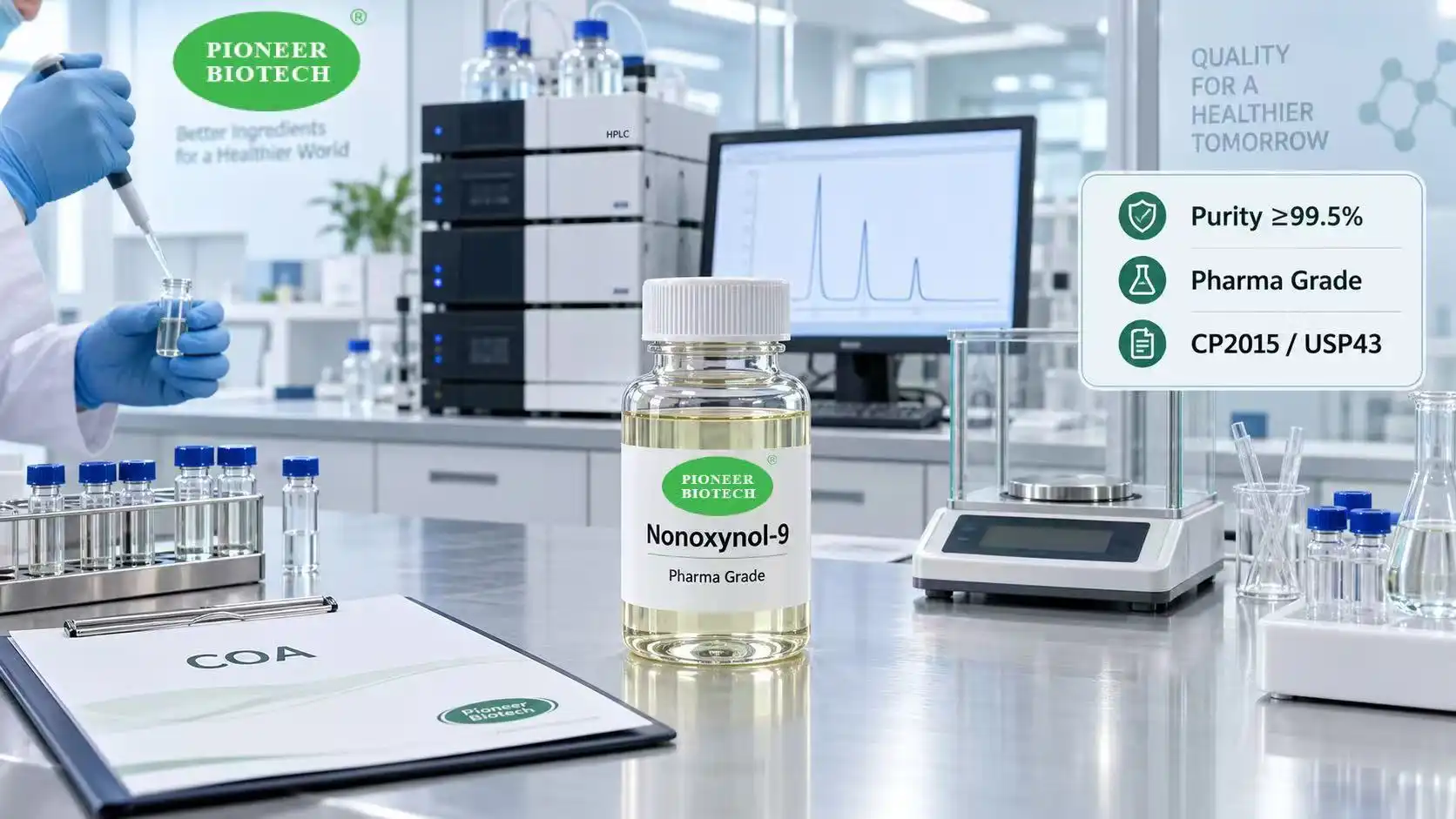
Understanding the Importance of Choosing the Right Nonoxynol-9 Supplier
Why Product Quality Has Direct Regulatory Consequences
Pharmacopeial monographs are very strict about nonoxynol 9. The USP 43 and CP 2015 pharmacopeias both set limits on the amount of ethylene oxide, 1,4-dioxane, and hydroxyl value that can be present (85–105 mg KOH/g). If your provider can't show that they're following these rules, it's a chance that your batch will fail quality control, your regulatory dossier will get weaker, and your brand's image will take the hit.
The compound is hard to make consistently outside of the lab because it has a Hydrophile-Lipophile Balance (HLB) of about 13.1 and a wide pH stability range (3.0–11.0). If you buy from a company that doesn't use approved testing methods, like NMR or mass spectrometry to check the average ethoxylation degree (n=9), you're agreeing that your active ingredient may vary in ways that can't be measured.
In the world of business-to-business, supplier screening is more important than ever because of changing prices for raw materials and stricter rules on chemicals around the world. Companies that don't go through an organized qualification process often find problems during production, which is a much more expensive time to fix them.
Core Criteria for Evaluating Nonoxynol-9 Suppliers
Certifications That Carry Genuine Verification Weight
Certifications aren't just for looks. When looking at a spermicidal surfactant supplier, you should make sure they have at least GMP compliance, ISO 9001, FDA registration, and HACCP/ISO 22000 certification. Kosher and Halal approvals add a useful level of compliance for brands that want to sell in markets with religious or dietary labeling rules. EU USDA Organic certification means that the source of the raw materials will be looked at more closely.
When a nonoxynol 9 seller is being qualified, these licensing standards should be checked:
- Pharmacopeial compliance (USP 43 / CP 2015): Makes sure the active substance meets the assay requirements, residual limits, and physical factors needed for medicinal use.
- FDA-registered manufacturing facility: This means that the plant is supervised in a way that meets U.S. market entry standards, which lowers the risk of import rejection.
- HACCP ISO 22000: Shows how to do structured risk analysis along the entire production chain, which is very important for personal care and private health uses.
- Kosher, Halal, and Non-GMO declarations: Make it possible for more people to buy the end product, especially in North America and the Middle East.
- BSE/TSE-free and paraben-free documentation: meets biosafety and clean-label requirements that are being pushed harder by beauty and nutrition brands.
Supply Chain Resilience and Production Capacity
A supplier's portfolio of certificates doesn't mean much if they can't keep things running smoothly. Check to see if the manufacturer has ready-to-ship items in nearby warehouses, provides clear wait times, and can increase production without lowering quality. Facilities with their own analysis labs that can do hydroxyl value titrations and determine molecular weight at 624.8 g/mol have the tools they need to make sure that each batch is the same.
Comparing Nonoxynol-9 Suppliers: What to Look For
Reputation Signals Beyond the Sales Deck
Third-party certifications that can be checked, production records that can be tracked, and customer relationships that have been recorded over a number of years are more reliable than self-reported performance metrics. Ask for a Certificate of Analysis (CoA) for the most recent production batches and compare the purity claimed (≥99.5% for pharmaceutical grade) with results from a different lab.
Depth of technical support is another thing that sets suppliers apart. When a maker helps buyers with the formulation of birth control gels, foams, or vaginal films and provides regulatory paperwork support, buyers don't have to do as much research and development (R&D). When a business is operationally maturity, it responds quickly to customer complaints and makes sure that guarantee terms are clear.
Flexibility in shipping is just as important. When suppliers offer quick, safe transportation along with help with paperwork (SDS, CoA, and customs documents), it cuts down on the paperwork problems that often cause product launches to be delayed.
Practical Steps to Source and Verify a Reliable Nonoxynol-9 Supplier
A Structured Qualification Roadmap for B2B Buyers
Instead of searching for vendors at random, the evaluation process works better with a planned, step-by-step method. By using well-known B2B chemical platforms and checking them against regulatory databases, you can make a first shortlist. From there, the following steps make the review more careful:
- Request product samples before committing to bulk orders. The nonoxynol 9 that is used in medicine should be a clear, colorless to light yellow, thick liquid with a slight smell. Any difference needs to be looked into further.
- Commission third-party purity and safety testing. Independent labs can confirm the hydroxyl value, residual solvent content, and average ethoxylation degree. This gives you objective data that is separate from the paperwork given by the seller.
- Negotiate contracts with explicit quality specifications. It is not enough to just assume that the agreement includes acceptable assay ranges, delivery tolerances, and rejection protocols; they should be written down. Clauses of confidentiality protect your recipe IP.
- Confirm local warehouse availability. Suppliers who keep stock in-country or in the area cut down on wait times and protect against problems with foreign shipping.
Applying this process regularly to all option suppliers generates a comparable dataset, making it possible for internal stakeholders to defend the final choice.
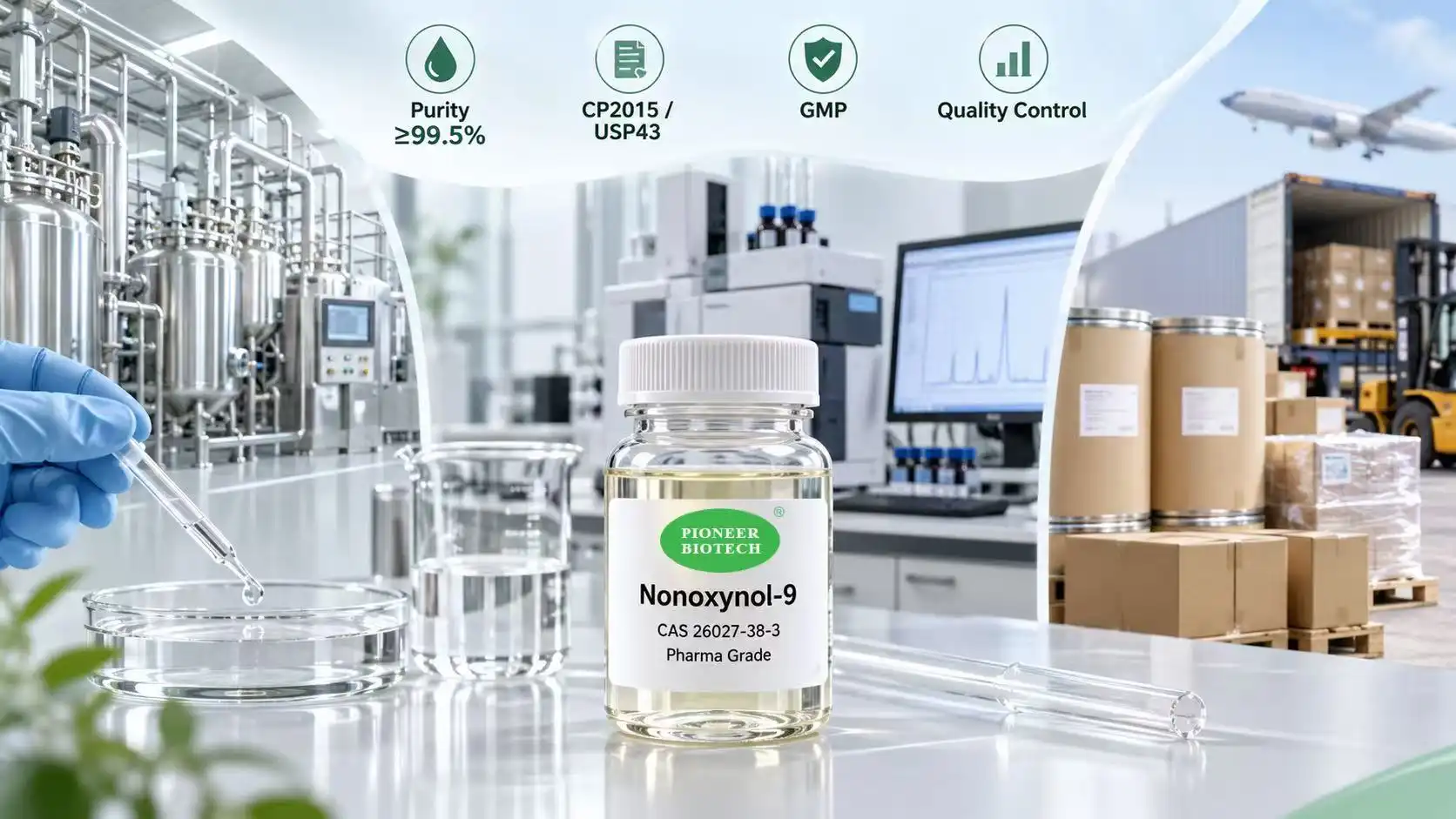
Case Studies: Successful Partnerships with Nonoxynol-9 Suppliers
A North American company that sells personal care products and needed nonoxynol 9 for a private label birth control gel line switched their supplier to a GMP-certified company that had confirmed they were following USP 43. The distributor got rid of three production delays caused by quality rejections with a previous vendor by requiring batch-specific CoAs and keeping a rolling 90-day inventory backup.
As part of making a vaginal microbicide formulation, a pharmaceutical contract manufacturer needed a custom viscosity profile and certain HLB characteristics. They worked closely with a supplier's technical team to make a specification sheet that met their needs for the end product. Time-to-market was cut by about four months, and the relationship cut down on the number of times products had to be reformulated.
Both examples show the same basic idea: when buyer needs and seller abilities perfectly match, procurement turns into a competitive benefit instead of a regular practical liability.
Conclusion
The same level of analytical rigor that is used for any pharmaceutical-grade active ingredient is needed to choose a nonoxynol 9 manufacturer. Wide range of certifications, the ability to validate analytically, the dependability of the supply chain, and a real technical partnership are some of the things that set qualified suppliers apart from commodity vendors. Buyers who use an organized approval process based on checked paperwork and independent tests protect both their product performance and their standing with regulators. The cost of thorough screening always goes down more than the cost of fixing mistakes in sourcing during production.
FAQ
1.Does nonoxynol 9 protect against sexually transmitted infections?
Not at all. Nonoxynol 9 does kill sperm, but there is no clinical evidence that it can protect against HIV or other STIs. When used often, it can irritate the skin, making it more likely to get an illness.
2.How should bulk nonoxynol 9 be stored?
Keep it between 15°C and 30°C in containers that don't let air in and out. Keep it away from direct light and heat. Extreme cold leads to thickening that can be undone, while too much heat speeds up oxidative degradation.
3.How is the ethoxylation degree (n=9) verified?
The average level of polymerization is checked by the hydroxyl value test, and it is confirmed even more by NMR or mass spectrometry analysis.
4.Can nonoxynol 9 be labeled as a natural ingredient?
Not at all. It is not natural or organic because it is a man-made surfactant made from nonylphenol and ethylene oxide, which are both industrial sources.
5.Does N-9 affect latex condom integrity?
As long as nonoxynol 9 is mixed correctly with water- or silicone-based lubricants, it doesn't affect the ISO 4074 standards for tensile strength or break resistance of latex.
Partner With Pioneer Biotech — Your Trusted Nonoxynol 9 Manufacturer
Pioneer Biotech has been dealing with pharmaceutical-grade active ingredients since 2012. Our factory in Hanzhong, China, is FDA-registered, ISO 9001-certified, Kosher-certified, and Halal-certified. Our nonoxynol 9 is ≥99.5% pure and meets USP 43/CP 2015 standards. We have it in stock, can help you with all the paperwork, and offer free samples. Reach our team directly at sales@pioneerbiotech.com or visit pioneerbioinc.com to request specifications and begin your supplier qualification today.
References
1. United States Pharmacopeia and National Formulary (USP–NF). Nonoxynol 9 Monograph. USP Convention, 2023.
2. World Health Organization. Medical Eligibility Criteria for Contraceptive Use, 5th ed. WHO Press, 2015.
3. Wilkinson, E. M., & Reno, H. E. L. Spermicides and Their Role in Contraceptive Practice. Contraception, 2018.
4. Raymond, E. G., et al. "Nonoxynol-9 and the Risk of HIV Transmission." The Lancet, 2001.
5. International Organization for Standardization. ISO 4074: Natural Latex Rubber Condoms — Requirements and Test Methods. ISO, 2015.
6. European Medicines Agency. Guideline on Residual Solvents in Pharmaceutical Products. EMA, 2018.